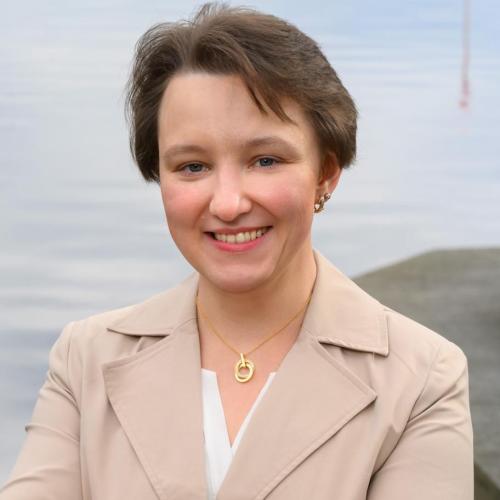

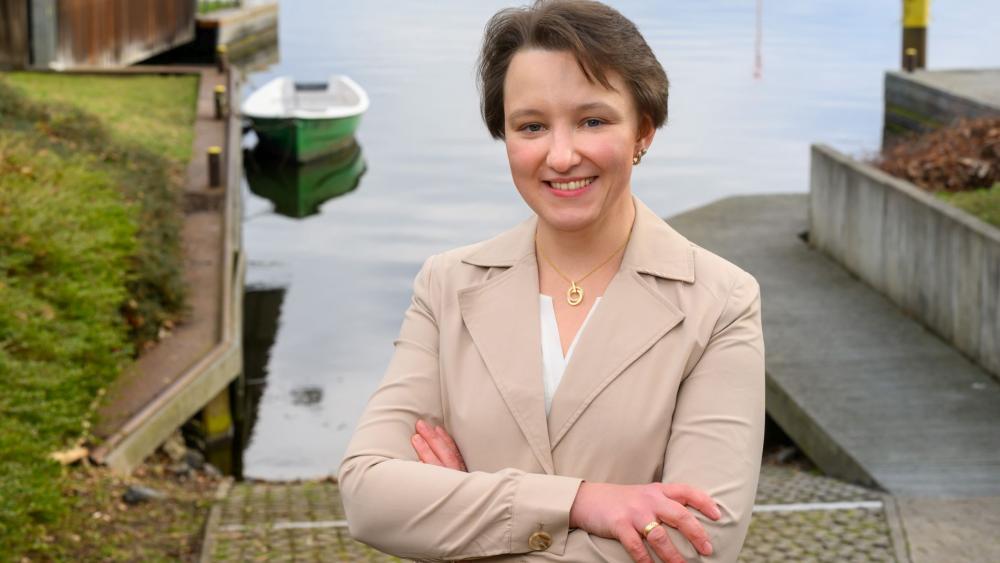
Dr. Oleksandra Shumilova at lake Müggelsee. | Photo: David Ausserhofer
Dr Oleksandra Shumilova has been a postdoctoral researcher at the Leibniz Institute of Freshwater Ecology and Inland Fisheries (IGB) in Berlin since 2019. She completed her master's degree at Admiral Makarov National University of Shipbuilding in Ukraine and her doctorate as part of the Erasmus Mundus programme “SMART” (Science for Management of Rivers anf their Tidal Systems) at Freie Universität Berlin and University of Trento in Italy, in cooperation with IGB.
Her research focuses on the dynamics, functioning and services of river systems and issues related to water infrastructure during and after armed conflicts. Since the war in Ukraine began in 2022, she has indeed been studying the warfare impacts on water resources. This research is personally significant for her as she comes from Mykolaiv, a city in southern Ukraine, that has been severly affected by water supply issues since the outbreak of the war in 2022.
Remote sensing is the only possible tool to do research in areas affected by the ongoing conflict in Ukraine
The Caroline von Humboldt Award enables the award winner to carry out a research project as a ‘Scientist in Residence’ during a research stay at the Humboldt-Universität zu Berlin. Oleksandra Shumilova will be hosted within the Geography Department being part of the Conservation Biogeography Lab led by Prof. Tobias Kümmerle.
“In my planned project entitled ‘IconicFlood’ I will be focusing on linking information from remotely sensed images to biodiversity patterns on river floodplains and how they are mediated by self-organization processes", said Oleksandra Shumilova. "This is particularly relevant for understanding the re-establishment of floodplains affected by extreme events such as floods and droughts. I will be analyzing riverine ecosystems affected by destructions of dams due to ongoing warfare in Ukraine. Remote sensing is the only possible tool to do research in areas affected by the ongoing conflict and make reliable recommendations for the management of impacted territories. However, interpreting information obtained from such sources requires understanding of complex interactions between various abiotic factors and biota happening on floodplains, which was a focus of my work at IGB during the last years. I am excited to extend this work and collaborate with a research group at HU, which is applying advanced methods of remote sensing in biogeographical research.”
Read the press release of the Humboldt Universität zu Berlin >