
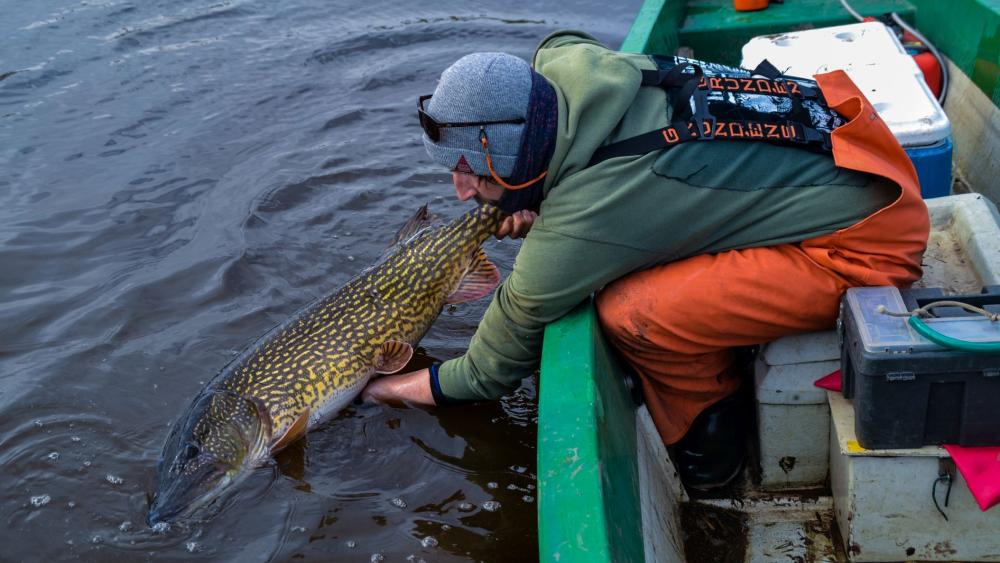
A large pike is carefully released by an angler. | Photo: Boddenhecht, IGB
The research team, led by Prof. Robert Arlinghaus from IGB and Humboldt Universität zu Berlin analysed around 19,800 catch records from anglers in Lower Saxony and Mecklenburg-Western Pomerania, which were collected as part of two one-year diary studies. The study examined the voluntary release of fish that are otherwise legally permitted to be taken. Species or sizes that are protected by fisheries law must always be released.
"Anglers carefully consider whether or not to actually remove a fish that they are legally permitted to take. Among anglers, and sometimes beyond, the practice of voluntary release – catch & release fishing – is controversial. Our findings help to assess the impact of angling on fish stocks and to place the controversial debate in a social context", said Robert Arlinghaus.
Sea fish and trout and salmon species are preferred, carp species less so
The researchers found that saltwater fish such as cod and herring, as well as salmon and trout (both salmonids), were kept significantly more often after being caught than common freshwater fish such as carp, pike or roach. The reason for this is that cod, trout and salmon are culturally perceived as being of higher culinary value in Germany than carp-like fish species (cyprinids) such as bream, tench and carp. These are significantly more bony. However, anglers from the east of Germany (Mecklenburg-Western Pomerania) took home significantly more cyprinids than anglers from the west (Lower Saxony). This finding points to a culturally based preference for the consumption of certain fish species. In Eastern Europe in particular, the consumption of cyprinids has a very long tradition that continues to this day.
Surprising and good for fish stocks: the largest fish are left to swim away
For most species, the likelihood of fish being taken after being caught was greatest for medium-sized fish. Large carp and pike in particular were voluntarily released much more frequently. This is good news for fisheries management and conservation, as it shows that many anglers voluntarily support the protection of particularly large adults, even though they could and, according to some authorities and angling associations, should take these megaspawners home.
The happiness factor
Anglers who were satisfied with their previous fishing experiences were more likely to release fish on future trips. "Past successes help determine future catch and release decisions: those who have caught well voluntarily release more fish on subsequent days. And in general, particularly successful anglers take fewer fish home after the catch", explained study leader Robert Arlinghaus.
Angler type, fishing ability and age are decisive as well
Those who catch a lot of fish take smaller numbers. The type of angler also played a role, in particular the degree of angling involvement, the harvest orientation and the importance of angling in an angler's life. Older people and anglers who fish irregularly and not very successfully kept more fish. A young person who fishes a lot and has a high level of fishing skill, on the other hand, voluntarily returns more fish to the water after the catch.
In contrast to earlier studies from the USA, it was not the case that people who were psychologically strongly connected to fishing also released more fish. In general, German anglers are much more consumption-oriented than anglers in the Anglo-Saxon world, which is reflected in the fact that even highly specialised anglers in this country take many fish home, e.g. when fishing for eel or cod. The situation is different when fishing for carp, pike or perch. Even in Germany, anglers who specialise in these species release more fish than those who are less specialised.
Culture has an impact: more fish are caught in Mecklenburg-Western Pomerania than in Lower Saxony
According to the study, cultural differences between eastern and western Germany play an important role in the decision to release fish. For example, anglers in Mecklenburg-Western Pomerania were more inclined to remove fish for consumption, while in Lower Saxony releasing fish was practised more frequently.
"The finding can be explained by different values and norms in western and eastern Germany, in particular a stronger subsistence orientation, which according to previous studies is more pronounced in eastern Germany. However, the result could also be due to the fact that fishing conditions in most waters in Lower Saxony are worse than in the less densely populated and water-rich areas of Mecklenburg-Western Pomerania. Anglers in Lower Saxony may see the release of fish as an opportunity to conserve the low fish stocks", said Robert Arlinghaus.
Conclusions for the management of angling
The study shows that the decision in favour of or against taking fish that can be taken for consumption depends on many factors. For some species groups, such as carp-like fish, voluntary release after capture is common practice and affects more than half of all fish caught. The situation is different for trout, cod, pikeperch or eel, more than 90 % of which are removed after capture if the animal exceeds the legal minimum size. Irrespective of this, the voluntary release of harvestable fish is widespread for almost all species and many anglers. This can contribute to the protection of endangered fish populations. It is important that anglers handle the fish carefully to maximise the likelihood of survival. According to previous studies, 90 to 100 % of released fish survive in the vast majority of species, especially if equipment and handling methods are used that cause minimal injury.
******
Read more on catch and release in recreational fishing:
In all German waters and most waters worldwide, there are length-dependent removal regulations in the form of minimum length limits. Fish above these lengths may be removed after being caught. The release of juvenile fish that are protected is mandatory, good practice and generally accepted. In Germany, as well as in some other countries (e.g. Switzerland), the voluntary release of legally removable fish is the subject of critical debate, as this can be seen as angling without the intention of consumption and therefore as angling without justification just for fun. However, this accusation can only be levelled at anglers who do not take any fish at all, i.e. who release everything. This affects a clear minority of anglers. Most practise selective harvesting, i.e. selected fish that can be taken are removed and others are carefully released. Surveys in Germany have shown that selective harvesting is considered an ethically acceptable practice by the majority of society, provided that the release serves to conserve fish stocks.
From a conservation perspective, the release of fish often makes sense to prevent overfishing. The ‘Waidgerecht’ project of the working group led by Professor Robert Arlinghaus is currently developing knowledge-based best practice recommendations on how the release of fish can be made as gentle as possible on the fish through the appropriate choice of tackle and fishing conditions.