

urbAnAquifer
Short profile
Duration
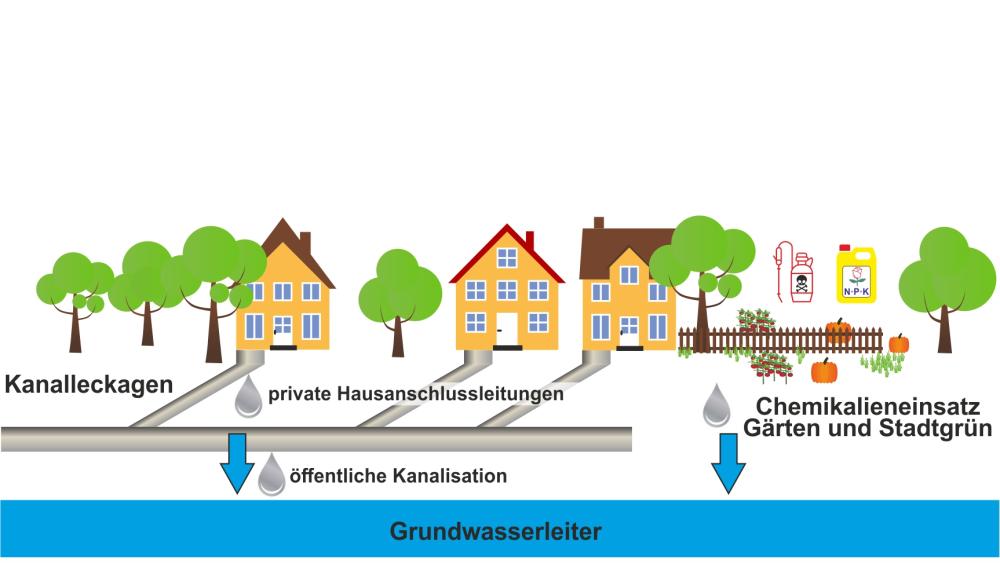
Aquifer contamination due to leaky sewers and the use of chemicals on green spaces © Jörg Lewandowski, IGB
Ubiquitous but often overlooked sources of groundwater pollution in cities are leaky (1) private and (2) public sewers and the use of (3) chemicals in gardens and green spaces (fertilizers, herbicides, insecticides).
Public sewers are regularly inspected to prioritize repairs and renovations based on its condition and extent of damage. However, little is known about the condition of private sewers that connect houses to the public sewers, even though the private sewers in Germany are about twice as long as the public sewers. It is estimated that in Germany up to 10 % of the wastewater (dry weather sewage) seep away on its way from households to wastewater treatment plants and contaminate the aquifer. However, on the groundwater side, it has hardly ever been recorded whether the aquifer is contaminated with wastewater.
Since there are usually too few groundwater monitoring wells to detect contamination and its potential sources, the project urbAnAquifer achieves significantly higher spatial resolutions when looking at aquifers including participation of citizens. Citizen scientists in Berlin are supporting urbAnAquifer by sampling their private garden wells. In addition, the project samples the large number of street emergency wells in Berlin.
Using two model areas in Berlin, transferable concepts are being developed that will make it easier to detect groundwater contamination throughout Germany caused by leaky (1) private and (2) public sewage systems or (3) the use of chemicals on green spaces, and to develop measures to prevent and, if necessary, remedy contaminations.
Active involvement in sampling campaigns is intended to raise public awareness of urban groundwater protection. So far, public awareness of urban groundwater has been low because, unlike other types of water, it is not visible. Homeowners are rarely aware that the condition of their private sewage systems can have a direct impact on local groundwater. Users of private gardens and allotments are far too rarely aware of the potential impacts on groundwater of using chemicals in gardens.
In dialogue processes and participatory workshops, an implementable and financially viable strategy will be developed together with homeowners, interested citizens, and public wastewater disposal companies to identify leaking private house connection pipes more quickly and to repair and replace them as necessary. Similarly, strategies will be developed together with interested citizens to reduce the use of chemicals in gardens and other green spaces.
In order to detect sources of pollution in groundwater better and faster, a multi-tracer approach is being tested in the project urbAnAquifer. With particular regard to leaky sewers, a transferable monitoring concept is being developed to identify sources of contamination and check whether sewer leaks or other sources are being overlooked.



Regina Gnirss, Berliner Wasserbetriebe (BWB); Michel Gunkel, Berliner Wasserbetriebe (BWB)

Deutsche Bundesstiftung Umwelt (DBU)