
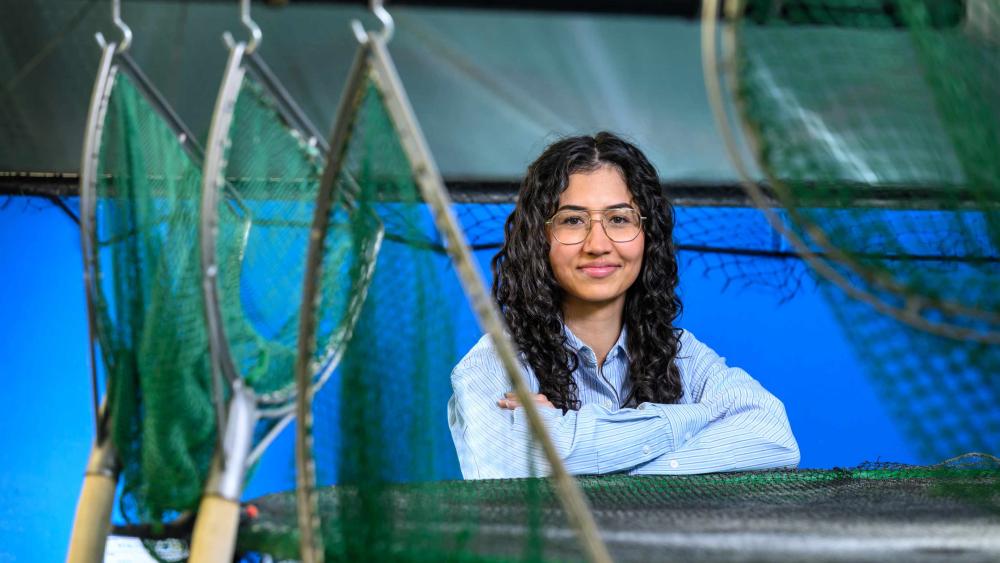
Natalie Klinard ist a new research group leader at IGB. | Photo: David Ausserhofer, IGB
Mrs. Klinard: 'Fish in motion in the wild'. What made you choose it as your research topic?
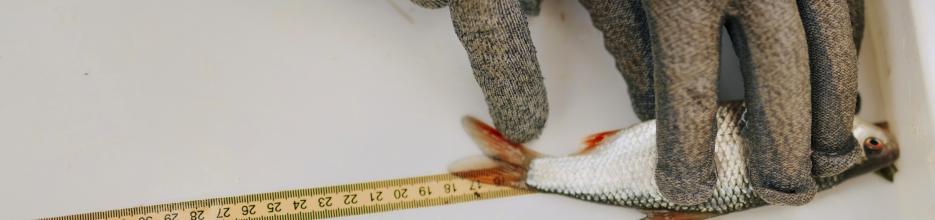
Movement is a fundamental part of life for all organisms. It plays a major role in most ecological and evolutionary processes and determines the structure of populations, communities, and ecosystems. Understanding animal movement can teach us a lot about how animals interact with their environment and navigate environmental changes. Fish have long held ecological, economic, social, and cultural importance in aquatic environments worldwide, driving a widespread desire to better understand their ecology and role in diverse ecosystems. Gaining insight into the movement and behavior of fish in their natural environment is something that has interested me since the start of my academic journey. However, the size and complexity of aquatic environments has historically made it challenging to monitor the movements of fish. In recent decades, advancements in aquatic telemetry technology have enabled the ability to track fish movements near-continuously for periods of months to several years and across spatial scales ranging from small lakes and rivers to entire ocean basins. These modern tracking technologies have broadened the scale and scope of research questions that we can address in relation to fish movement and behavior. Being able to study the causes and consequences of fish movement in increasing detail using new technologies has really reinforced my passion for studying fish movement in the wild.
Could "A life for science" be the subtitle of your biography one day? If not, what would you consider an appropriate alternative?
I think ‘A life for science’ could certainly be the subtitle of my biography one day – if I ever have one! As a child, I grew up with an appreciation for the natural world and a vast curiosity about how it worked. At its core, science is really about pursuing a desire to explore and understand phenomena in our world and building new knowledge as we do so. Even though science has become my career, I think the foundations of what made me pursue science still shape a lot of how I move through the world and my everyday life.
If you were a migratory fish free to swim wherever you wanted, where would you go?
This is a tough question to answer because the possibilities feel endless, but I would love to be an Arctic char migrating between rivers and the Arctic Ocean. I think it would be incredible to see such extreme and unique environments in a climate that would be considered a harsh place to live for humans.