
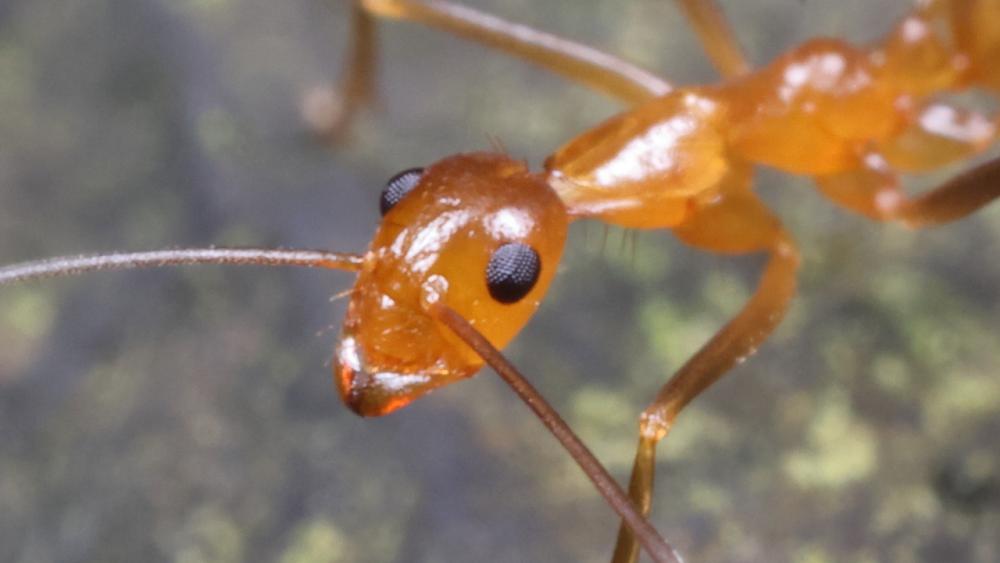
The yellow crazy ant (Anoplolepis gracilipes) is an invasive species causing animal welfare impacts. | Photo: Rainer Breitling
In their study, Dr Thomas Evans (Institute of Biology, Freie Universität Berlin and Leibniz Institute of Freshwater Ecology and Inland Fisheries (IGB)) and Professor Michael Mendl (Bristol Veterinary School, United Kingdom) present the Animal Welfare Impact Classification for Invasion Science (AWICIS) – a novel framework for quantifying the severity of the animal welfare impacts of biological invasions.
AWICIS identifies relative changes to the welfare of an individual animal using five impact severity categories. Evidence for welfare impacts is provided using physical, behavioral, or physiological indicators (for example, physical injuries, lethargy resulting from the effects of a disease, and elevated stress hormones as a marker of the threat of predation, respectively).
“AWICIS can be used in research and policy development to evaluate the threat to animal welfare posed by biological invasions”, said Thomas Evans. “AWICIS sheds light on a major type of impact caused by biological invasions which has not received the attention it deserves.”
To test AWICIS, the authors applied the framework to published data on the impacts of two groups of introduced species – birds and ants. Their results indicate that the welfare of animals such as birds, turtles, lizards, and crabs can be negatively affected by alien ants such as the red imported fire ant (Solenopsis invicta). These welfare impacts were identified using behavioral indicators, including diminished sleeping behavior and excessive preening, and physical indicators such as injuries resulting from predation by ants. In many cases, these injuries led to long, drawn-out deaths.
Alien birds also affected the welfare of animals, but overall, their impacts tended to be less severe than those caused by alien ants. The authors note that evidence of welfare impacts from physiological indicators was scarce, and that this evidence may be useful to identify certain types of welfare impacts – particularly those that are less obvious or visible.
The authors acknowledge that there are significant data gaps on animal welfare impacts caused by biological invasions, and appeal to fellow researchers to help produce a more complete picture of these impacts. “Our dataset is skewed toward high-income regions, so we encourage researchers to gather data on welfare impacts when undertaking field research in low-income regions”, said Thomas Evans. “As assessment template has been developed for AWICIS. It can be used by researchers wishing to report and assess the animal welfare impacts of biological invasions.”
This text is based on the press release of the Freie Universität Berlin >