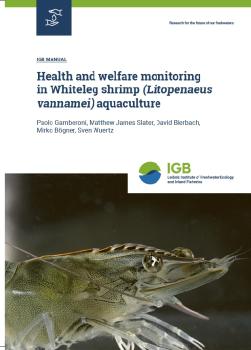

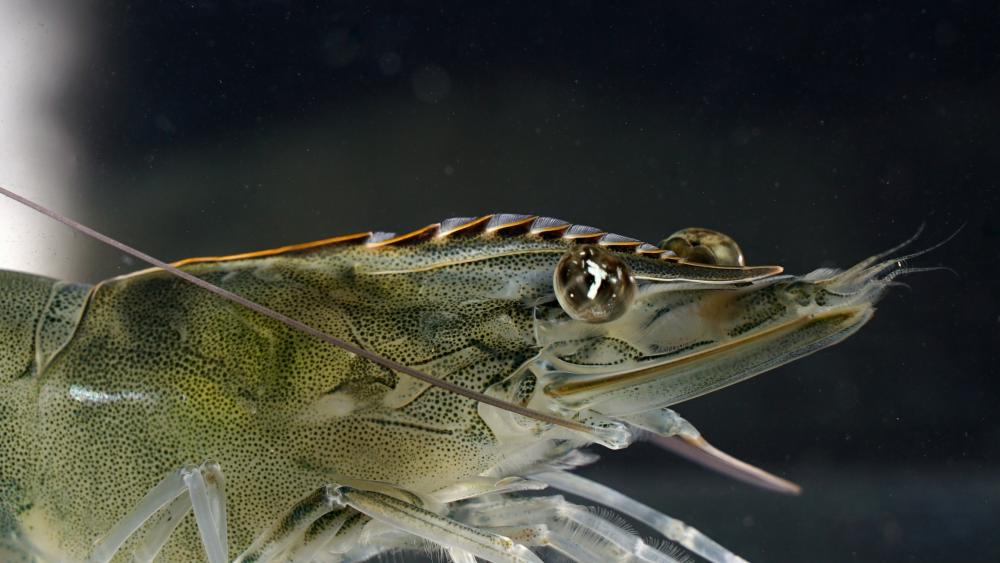
Whiteleg shrimp (Litopenaeus vannamei) | Photo: Mirko Bögner
The publication focuses on Whiteleg shrimp (Litopenaeus vannamei) farming and especially addresses practitioners, companies and associations from the aquaculture sector to foster animal welfare aspects in shrimp farming. It can also serve as a reference resource in experimental settings or routine farm observations, particularly at small-scale, where standardised operational protocols are often less developed and common.
A morphological index to assess shrimp well-being and welfare
Animal welfare is often framed around the “Five Freedoms”: freedom from hunger and thirst; discomfort; pain, injury and disease; fear and distress; and the freedom to express normal behaviour. While originally developed for vertebrates, these principles are increasingly discussed for invertebrates in aquaculture. For shrimp and other decapod crustaceans (such as crabs and lobsters), key welfare issues include hatchery practices, transport, stocking, keeping and slaughter. The IGB Manual puts emphasis on the morphological modifications under stress conditions. The index integrates the authors’ own findings with results from previous studies and provides detailed descriptions and photographic evidence to support consistent evaluation. Morphological lesions are presented through figures, along with recommended observation procedures. Experimental results and farm observations are described to support the index interpretation. This can enable practitioners to monitor the animal condition and health over time.
Feedback from practitioners is welcome
“We invite shrimp experts to provide feedback and suggestions, and to submit filled morphological index forms for expansion of the dataset”, said IGB scientist Dr Sven Wuertz, co-author and head of the Molecular Fish Physiology research group at IGB. The publication was developed together with scientists from Alfred Wegener Institute, Helmholtz Centre for Polar and Marine Research; the Humboldt-Universität Berlin, and also summarises the findings from the “CrustaWohl” project, funded by the German Federal Environmental Foundation (DBU).
The IGB Manual can be downloaded below this text.