Photo: David Ausserhofer/IGB
Dr Kimmig, could you tell us a little about yourself: How did you get into writing beyond science? Or was it perhaps the other way round?
Sophia Kimmig: First and foremost, I’m a scientist. I came to writing more by chance – through my scientific work. As part of my PhD thesis on urban foxes, I was in frequent contact with the press and broadcast media. That’s when I realised how much I enjoy sharing my enthusiasm for a topic with others. MALIK Verlag came across one of the media features I’d contributed to at the time and asked me if I could imagine writing a book. My first thought was: ‘I can’t imagine it, but I’d certainly like to try!’ I had my doubts as to whether I could actually do it. Fortunately, it turned out to be a good book after all [laughs]: ‘Von Füchsen und Menschen’ made it onto the SPIEGEL bestseller list.
And that wasn’t to be the only recognition. Your latest book, ‘Move!’, has just been named ‘Science Book of the Year 2026’ by ‘Bild der Wissenschaft’. What does that mean to you?
SK: To be honest, when I received the nomination email in summer, I didn’t harbour the slightest hope and didn’t give it a second thought afterwards. After all, with awards like this, you’re competing against books from the global market. But that makes me all the more delighted about the award now! Unlike bestseller lists, which primarily reflect how often a book has been purchased within a certain timeframe, this award is about a book’s content and literary quality: how successfully does it show people just how exciting and fascinating scientific topics are? I’m therefore very honoured and delighted that my work is being recognised in this way.
Which do you actually find easier to write: a scientific article or a non-fiction book?
SK: I often don’t find scientific writing all that enjoyable. For me, the exciting part of science happens before the writing: discovering new knowledge, formulating hypotheses, brainstorming, trying things out, and conducting experiments to see the results. Summarising the findings afterwards is, for me, more of a necessary step to make them accessible. It’s different with popular science writing: there, I also discover new things while writing, can establish interesting connections, and creatively link different elements. I start by gathering a lot of material, and the texts gradually emerge from it.
So you gather material first, before you start writing. And then what? Do the texts take shape in a fixed order, or do you prefer to start with a particular section?
SK: The process of creating non-fiction books is both structured and chaotic. I start by writing an outline and a table of contents, and then the texts themselves emerge quite spontaneously. I always write the section that I currently have a clear vision for, regardless of where it ends up later. For my current project, I even wrote the last page first. I was lying in bed when I suddenly thought, ’I want to write that down’. It’s different with children’s books. There, I write the story from start to finish once, and then go back later to revise the sections.
How much science is there in your books – and how much room is there for entertainment and perhaps even fantasy?
SK: The content of my books is always closely linked to science. To achieve this, I read a large number of scientific papers. Often, I use even more sources than I would for writing a research article, as I also draw on texts from outside my own field, and even beyond biology – ranging from philosophy to poetry. From this, I develop a narrative framework through my personal perspective, which interprets the material and gives the book its own distinctive style; much like curating an exhibition. Over time, I’ve experimented more and more with the narrative approach. Whilst my first book relied more on anecdotal storytelling, I took a different approach for ‘Move!’: I wrote fictionalised non-fiction for the first time, by looking over the shoulders of various animals, so to speak, and telling their stories. Every animal I feature actually existed, and I have thoroughly researched the background information. I then fleshed out the stories themselves using my imagination. I really enjoy doing that. My next children’s book will be even more fictionalised. However, the same principle applies there too: the information on which the stories are based is always fact-based.
Is there an animal story that particularly captivated or moved you whilst you were writing it?
SK: I don’t have a single favourite protagonist, but some animals have captivated me more than others. The Arctic fox, for example: I’m moved by the idea that such a small animal, weighing only about two kilograms, can travel thousands of kilometres across the frozen sea. I also found it fascinating to see things from the eel’s perspective. Its tiny larva hatches in the depths of the Sargasso Sea and then embarks on a journey lasting many years, at the end of which it returns as a fully-grown eel. I wondered what it must feel like to be driven by an urge whose origin is unknown. And then there’s the rat, which is tagged by researchers and released on an island and, although it finds everything it needs to survive there, swims across the sea to another island. Presumably, it was seeking social contact. It is scientifically proven that rats are highly social animals. What exactly motivated this rat to undertake its journey remains, of course, a matter of interpretation.
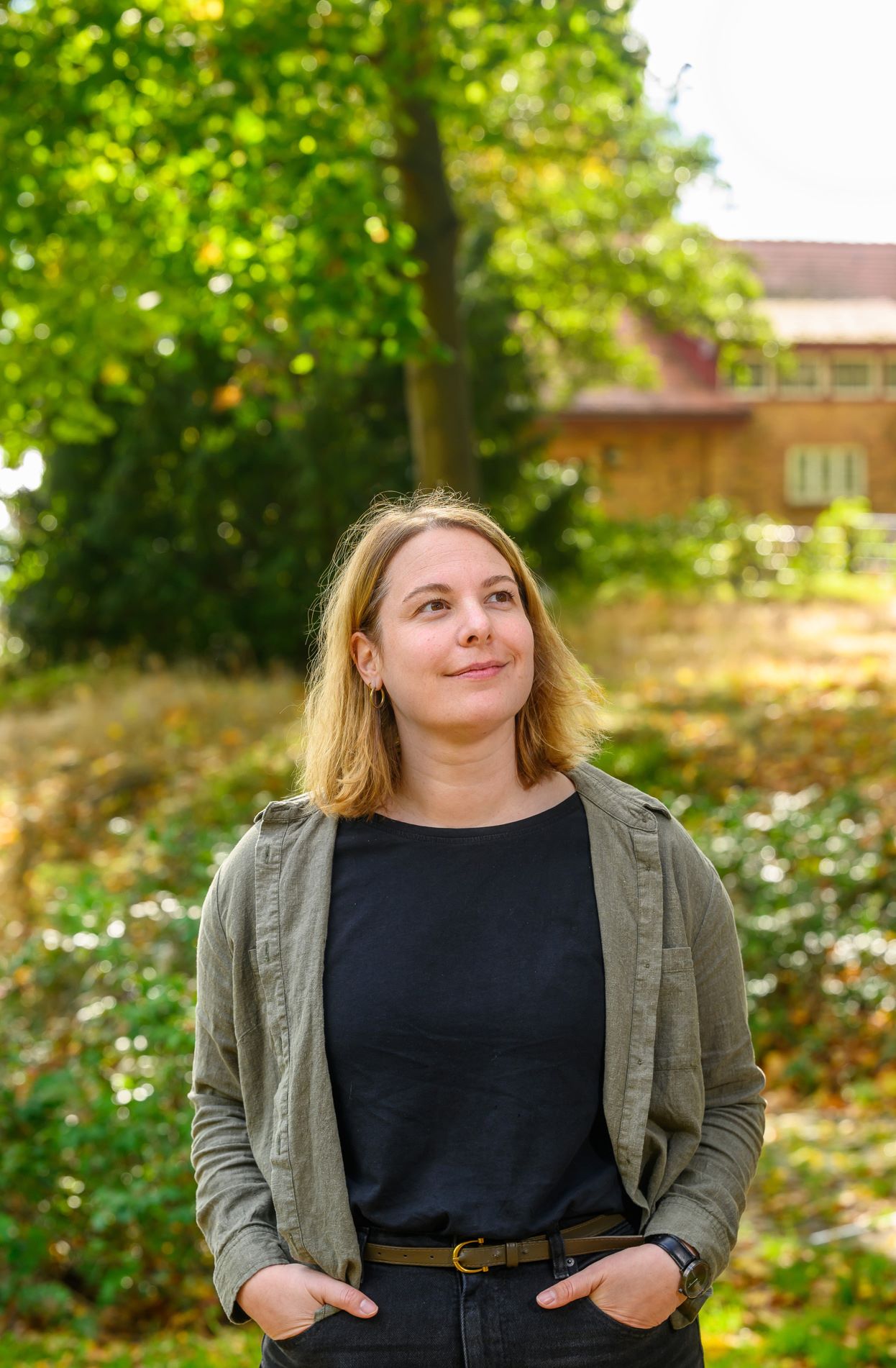
Foto: David Ausserhofer/IGB
"I can’t think of a single research topic that couldn’t, in principle, be turned into a book or a game. It’s more a question of how. Even topics that initially seem too complex, too broad, or too specific can be approached in some way."
Dr Sophia Kimmig
What advice would you give scientists who’ve had an idea for a book in mind for a while but haven’t yet dared to start writing?
SK: Go for it! Curiosity is perhaps the most important driving force behind science. I can only recommend giving free rein to that curiosity when writing as well. I even believe that the two complement each other wonderfully and reinforce one another: scientific work and popular science writing.
You don’t just convey scientific findings in books, but also develop games together with colleagues. Why?
SK: I’m very interested in science communication, and I think games have particular potential: they enable simulation and first-hand experience. Rather than passively absorbing content, players can become part of the message – for example, by stepping into a specific role and experiencing a situation from that perspective. They can experiment, make decisions and even experience failure. This fosters a strong sense of self-efficacy, because you experience the impact of your own actions first-hand. For me, this is precisely where games’ particular strength lies: scientific knowledge is not just conveyed, it can be actively experienced and, in this way, understood differently.
One such game is 'BioInvaders! Reef Rush'. What is it about?
SK: Reef Rush was developed as part of the GuardIAS European research project, in collaboration with Paidia, IGB, the Freie Universität Berlin, and the University of the Aegean. In this card game, two to five players explore the underwater world of the eastern Mediterranean together. The aim of the game is to build a reef and try to curb the spread of the invasive lionfish, which has migrated from the Red Sea via the Suez Canal. In doing so, players not only learn about the impacts of invasive species and potential management measures, as well as native Mediterranean species and the importance of ecosystem health for resilience to environmental change.
How does current research become a game where you learn something along the way? What is the first step?
SK: We develop different types of games. Some are aimed at specific interest groups, others at the general public. Reef Rush falls into the second category. So, I always start by asking myself: 'Who is the target audience, and what do we want to convey to them?'
And what happens next until the game is finished?
SK: Bearing this basic idea in mind, I engage in discussions with the game developers, who suggest suitable game mechanics. Together, we discuss and further develop the concept. The next step is to provide a scientific basis for the game idea: What is the current state of research? Which facts and findings should be incorporated into the game? Storytelling is also important here; scientific content does not necessarily have to appear directly in the game’s text. It can also be embedded in the plot or the design. To keep track of everything, I sometimes use tables to collect scientific facts and publications, noting where they can be conveyed in the game. In this way, scientific research, playful design and expert review all interlock.
In October 2026, the game won an award in the ‘Games in Development’ category at the International Educational Games Competition, which was held as part of the 20th European Conference on Games-Based Learning…
SK: … exactly, that’s an award for games that are still in development. So, Reef Rush isn’t available yet. However, we have already tested the prototype with the target audience at various events and refined it based on their feedback. This feedback is now being incorporated into the final details. After that, the game will go into production.
When and where will Reef Rush be available?
SK: It is planned for release next year. As the game has been publicly funded, it’s intended to be made available for free later on, including as a so-called ‘print-and-play’ version. This means you can print out the cards yourself at home and start playing straight away. In addition, you’ll be able to purchase a professionally produced version at cost price.
Is there a research topic that absolutely ought to be turned into a book or a game?
SK: Actually, everything! The great thing about literature and games is that there are no limits. I can’t think of a single research topic that couldn’t, in principle, be turned into a book or a game. It’s more a question of how. Even topics that initially seem too complex, too broad, or too specific can be approached in some way. The challenge lies in finding that approach. The key is to have someone who is genuinely enthusiastic about the topic and can convey what makes it so fascinating. Building on that enthusiasm, it’s possible to develop a story or a gaming experience that will resonate with others too. I have so many topics in mind that I can hardly imagine ever running out of material.
The interview was conducted by Angelina Tittmann.
Read more on the topic
Who needs immortality, when there is freedom? – a comment by Sophia Kimmig
Go to the book: Move! Wie Fortbewegung das leben der Tiere bestimmt
~
Other IGB scientists are also creative writers alongside their research. For example, in his novel ‘Glücksreaktor’, Dr Max Wolf tells a story about friendship and freedom. Dr Gabriela Costea, for her part, has published a children’s book entitled ‘Lau lacht wieder’, which she specifically uses for environmental education in the Danube region.