



1) Biodiversity in a Changing World
Selected publications
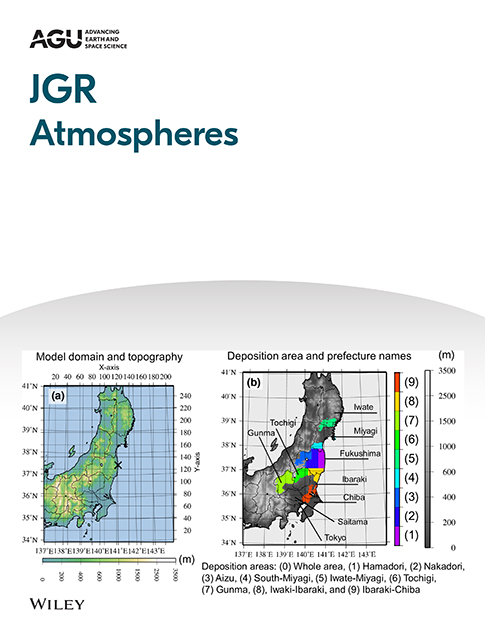
August 2026
JGR Atmospheres. - 131(2026)16, Art. e2026JD046723
High-Resolution Regional Atmospheric Simulation of Precipitation and Isotopes in Central America
The authors used an isotope-enabled spectral model to improve the simulation of precipitation and its isotopic composition over Costa Rica to assess the feasibility of using atmospheric model outputs as forcing data for ecohydrological models. When simulating long-term hydrological processes the model outputs provide a reliable source of forcing data and can be used for hydrological forecasts.

August 2026
Water Research. - XX(2026)X, Art. 126747
Tracing the occurrence and spatial drivers of organic contaminants in urban ponds along urbanization gradients
This study presents a multi-tracer approach to investigate the impacts of urbanization on pond pollution at the city-scale, linking trace organic contaminant data, urban hydrology, and urbanization measures. In Berlin, urban ponds contained a wide variety of dissolved organic contaminants, with water inflow being a more important driver of high contaminant concentrations than surrounding land use.

June 2026
Hydrological Processes. - 40(2026)7, Art. e70625
Trade-Offs in Constraining Evapotranspiration Estimates in Complex Landscapes Using a Tracer-Aided Ecohydrological Model
ET interacts with multiple hydrological processes: groundwater recharge, lateral flow and streamflow. The inter-linkages become increasingly complex in ET-dominated regions with intensive management. We showed how tracer-aided modelling captures ET dynamics and how trade-offs between discharge and other observations are reflected in simulated hydrological flux/storage patterns.

June 2026
Hydrology and Earth System Sciences. - 30(2026)12, 3715–3739
Exploring impacts of forest management strategies on water partitioning in a drought-sensitive catchment using a tracer-aided ecohydrological framework
The authors developed a parsimonious, tracer-aided forest management scenario framework using an ecohydrological model, which was designed to isolate the dominant vegetation-structural controls on long-term water partitioning. Evapotranspiration was highest under conifers, exceeding broadleaf forests and agroforestry by 7 % and 11 %. Agroforestry exhibited the greatest groundwater recharge.

May 2026
Geophysical Research Letters. - 53(2026)10, Art. e2025GL120780
Prediction of Hydroclimatic Anomalies Using a New Isotope Precipitation Index
The authors used stable water isotopes to trace the origin of precipitation and are developing a new, isotope-based Evaporation and Moisture Recycling Index (iEMI). The iEMI can identify anomalous dry periods and links evaporation-driven precipitation to droughts in Europe, Africa, and Australia. This innovative index can help improve drought monitoring and optimize water management worldwide.


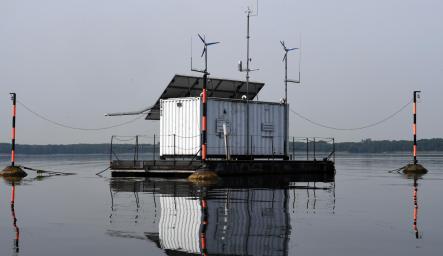
Monitoring stations
-
Water temperature-
-
Oxygen (rel./abs.)- / -
-
Wind speed-
Last measurement: No data available.
-
Water temperature-
-
Oxygen (rel./abs.)- / -
-
Wind speed-
Last measurement: No data available.
-
Water temperature-
-
Oxygen (rel./abs.)- / -
-
Wind speed-
Last measurement: No data available.