
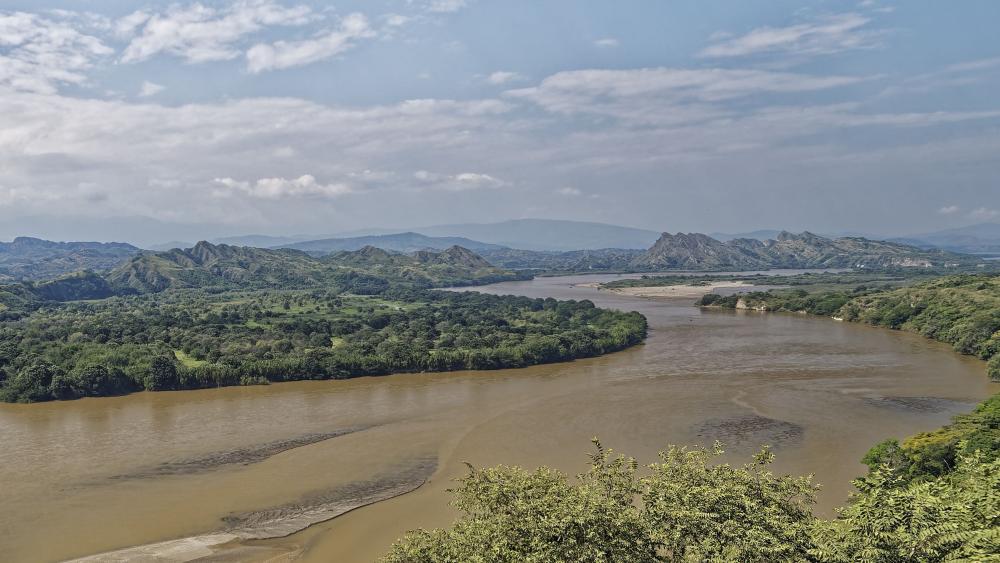
The research team investigated the geographical distribution of 1,313 freshwater fish species across 38,000 river sub-catchments in Colombia. They compared this data with existing protected areas, which aim to protect all animal species. In doing so, they found that whilst the area required for the effective protection of fish species is similar in size to that of existing protected areas, there is a significant spatial discrepancy: the optimal protected areas and the current protected areas overlap by only 25 per cent.
“This gap highlights how important it can be to revise existing conservation strategies in order to preserve freshwater biodiversity more effectively”, said Thomas Tomiczek, lead author of the study and a researcher at IGB.
It would be particularly important to grant protected status to the upper reaches of the Orinoco River, which, with 964 fish species, is as species-rich as the Colombian section of the Amazon but is home to more endemic fishes. Endemic species are those found exclusively in a specific area. Many endemic and threatened species also live in the Magdalena-Cauca and Pacific-Chocó basins, which is why they are represented to a large part within the newly defined priority areas.
The study identified only one river basin with a high degree of overlap (72 per cent) between existing protected status and prioritised protected areas: the Rio Bita in north-eastern Colombia on the border with Venezuela, which has been protected since 2018. Overall, the researchers conclude that it would be important to protect more headwaters, as they are particularly sensitive to environmental changes and perform essential functions for the entire river network. Furthermore, smaller tributaries of major rivers should be taken into account, as during floods they can collectively provide a mosaic of diverse habitats.
Discrepancy in protected areas also evident for other animal groups
The discrepancy between biodiversity hotspots and protected areas in Colombia has also been documented in other studies for mammals, birds, amphibians and reptiles.
“Such findings can therefore serve as a guide for integrating areas of high ecological value and low human impact into future conservation strategies, in order to protect as many animal species on land and in water as possible”, said Dr Sami Domisch, researcher at IGB and lead author of the study.
Another study shows a similar picture for Europe's rivers
The study’s findings align with the picture painted for Europe's rivers by a study in Nature Communications led by the Senckenberg Society for Nature Research, IGB was also involved. In this study, the international team analysed over 1,700 river sites across ten countries over nearly four decades. The results show that protected areas are often insufficient to significantly increase biodiversity and water quality, as they were frequently designated for terrestrial ecosystems.
About the study:
The study is based on a compilation of 238,278 geographical records for 1,313 freshwater fish species. The species data were cleaned by harmonising the nomenclature and revising georeferenced coordinates. Using the GMTED digital elevation model, a river network was delineated and 38,150 sub-catchments were extracted, which served as spatial units for the analysis. Ensemble species distribution models predicted potentially suitable habitats for individual fish species across the entire study area. Spatial prioritisation analyses were then carried out, in particular integer linear programming, to account for 30% of each suitable habitat for each fish species within the newly delineated priority areas.