


1) Biodiversity in a Changing World
Selected publications

March 2026
Diversity and Distributions. - 32(2026)3, Art. e70168
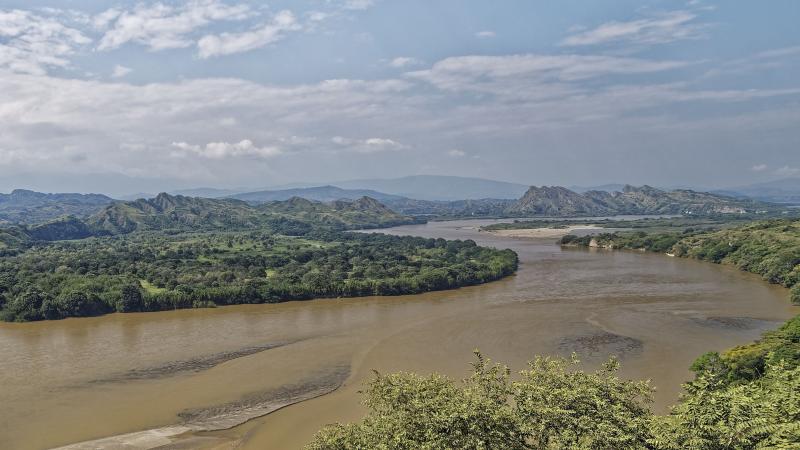
The Spatial Discrepancy Between Colombian Freshwater Fish Suitable Habitats and Existing Protected Areas
The study shows: Only 25 per cent of newly-delineated priority areas identified for the protection of freshwater fishes in Colombia overlap with existing protected areas. Strikingly, the required amount of area is similar to that of the existing protected areas. However, a more efficient spatial distribution would be important.

March 2026
Communications Earth & Environment. - 7(2026), Art. 303
A collaborative research agenda for restoring free-flowing rivers
The Nature Restoration Regulation (NRR) calls for restoring at least 25,000 kilometres of free-flowing rivers by 2030. Translating this ambition into implementation remains challenging due to differing restoration priorities across ecological, social, economic and governance contexts. This study offers a roadmap to support the implementation of the NRR's goal of restoring free-flowing rivers.

March 2026
Water Resources Research. - 62(2026)3, Art. e2025WR041376
A Novel In Situ Experimental Setup for Studying the Impact of Bedform Celerity on 2D Oxygen Distribution in the Hyporheic Zone of Streams
The authors investigated the influence of dynamic hyporheic zones. They developed of a novel field-based setup that enabled the simultaneous monitoring of oxygen dynamics and bedform migration in a stream. Contrary to what has been reported in several studies, they observed more strongly oxygenated bedforms at the highest velocity studied.

March 2026
One earth. - XX(202X)X, Art. 101623
Global assessment of alien freshwater megafauna reveals complex socio-economic impacts
This study shows: Over 40 percent of extant large freshwater animals (megafauna) have been deliberately introduced outside their natural ranges, often for economic gain. While these alien species can provide substantial benefits to certain groups in the introduced regions, they also posed profound and often underestimated risks to native biodiversity and local people.
February 2026
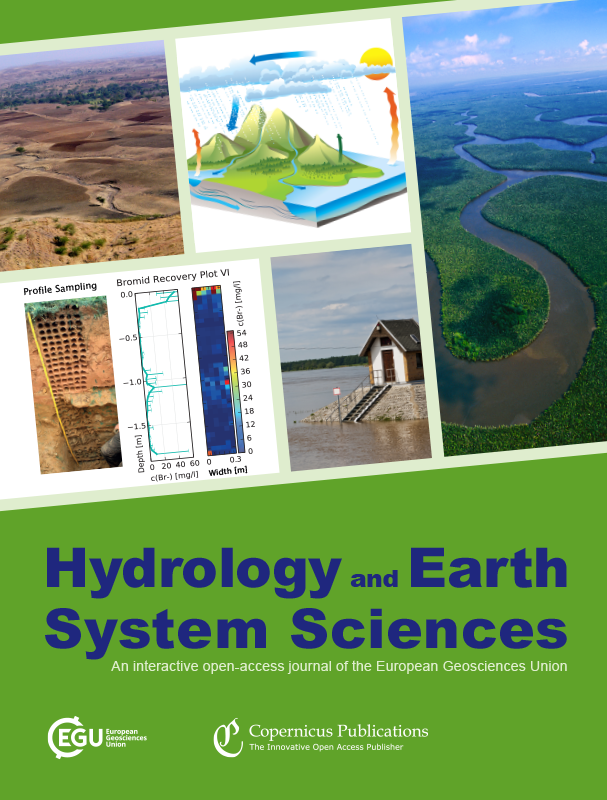
Hydrology and Earth System Sciences. - 30(2026)4, 1143–1163
Enhancing process interpretation with isotopes: potential discharge-isotope trade-offs in ecohydrological modelling of heavily managed lowland catchments
The authors enhanced a tracer-aided hydrological model to help constrain estimates of ecohydrological partitioning and water balance compartments in sub-catchments of the Middle Spree catchment. They disentangled ecohydrological funtioning in this ET dominated region despite the complexity of the heterogeneous landuse, extensive hydraulic infrastructure and long legacy of intensive management.


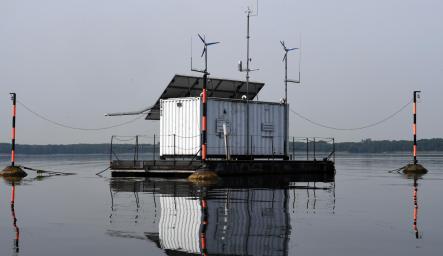
Monitoring stations
-
Water temperature-
-
Oxygen (rel./abs.)- / -
-
Wind speed-
Last measurement: No data available.
-
Water temperature-
-
Oxygen (rel./abs.)- / -
-
Wind speed-
Last measurement: No data available.
-
Water temperature-
-
Oxygen (rel./abs.)- / -
-
Wind speed-
Last measurement: No data available.