
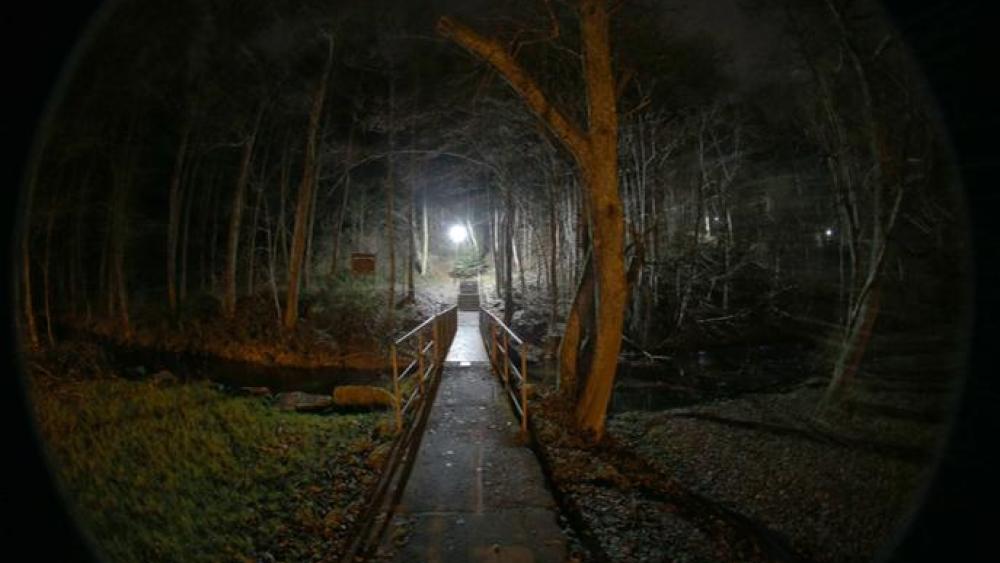
Example photo of unshielded path lighting in a nature reserve. | Photo: Andreas Jechow
‘As part of a comprehensive ecological risk assessment, we have determined threshold values that should not be exceeded in order to protect particularly sensitive species and habitats. Our findings show that significant ecological effects occur at illuminance levels of less than 1 lux,” explains Dr Franz Hölker, co-author of the study and head of the IGB research group on light pollution and ecophysiology.
‘Until now, there have been few binding regulations on light emissions, while a multitude of different non-binding recommendations have become established.’ Section 41a of the Federal Nature Conservation Act (BNatSchG) provides for a statutory instrument which is intended to contain specific and binding requirements for the first time. Developing these requires balanced consideration of conservation and land-use interests, as well as practical feasibility and enforceability for public authorities, businesses, and private individuals,’ explains Dr Benedikt Thiggins, legal scholar and lead author.
Spatial protection concept and a new approach to measuring light quantity and distribution
The researchers propose a spatial protection concept as a central approach. This involves assessing lighting installations based on their location: in areas used by people, or in areas worthy of protection.
To implement this, the concept of a 'fictitious assessment wall' has been developed. According to this concept, the illuminance level of each lighting installation must not exceed a specific threshold at the transitions between areas in use and areas worthy of protection. The proposed thresholds take into account diurnal and seasonal variations in the protection needs of species and habitats. This approach enables planned lighting installations to be assessed on the basis of photometric calculations at the planning permission stage, while also facilitating subsequent checks through on-site measurements. In this way, the two key influencing factors – light output and distribution – can be effectively controlled.
Feasibility and stakeholder involvement are essential for success
“Feasibility was absolutely central to us. The proposed regulations are designed to make the most efficient use of existing administrative procedures and limit additional administrative burdens,” emphasises Benedikt Thiggins. In line with Section 41a of the Federal Nature Conservation Act (BNatSchG), the requirements apply only to new lighting installations and significant modifications to existing ones, although the legislator has stipulated a retrofitting obligation for street lighting on public roads. ‘For the latter, a proposal for a proportionate, protection-oriented retrofitting obligation was developed based on empirical studies,’ explains the legal scholar.
‘From the extensive preliminary work in lighting research, we were of course already aware of the societal conflicts between protection from and the use of light. That is why we involved numerous expert and interest groups in the process right from the start. This was essential for achieving a technically sound, balanced outcome that also enjoys a high level of social acceptance,' explains co-author Dr Sibylle Schroer, who was responsible for stakeholder engagement.
Background
The introduction of Section 41a of the Federal Nature Conservation Act lays the groundwork for the establishment of specific measures, as set out in a statutory instrument, to protect animals and plants from the effects of artificial lighting. This protective provision will come into force once a statutory instrument setting out the specific requirements has been issued. The present research findings provide scientifically sound regulatory options, forming the basis for an effective and practical protection framework. Notably, compared with the regulation of similar environmental impacts (such as noise or air pollution), the scientific and legal foundation for a statutory instrument based on Sections 54(4d) and 6b of the Federal Nature Conservation Act has identified specific limit values.