
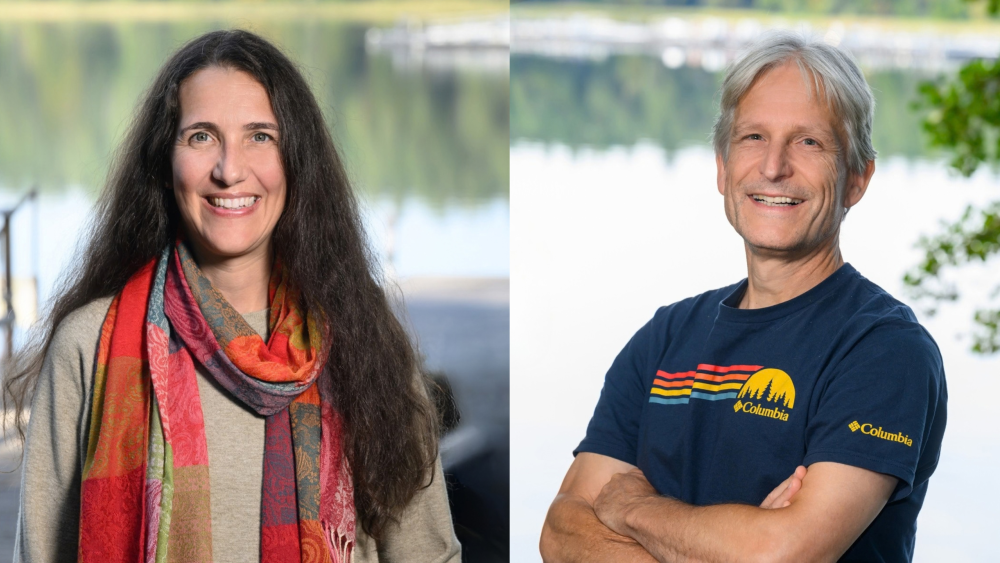
Sabine Wollrab and Hans-Peter Grossart are the Co-Heads of the Department of Plankton and Microbial Ecology at Lake Stechlin. | Photos: David Ausserhofer/IGB
Ms Wollrab and Mr Grossart, please tell us a little about yourselves. Which stages or experiences in your scientific careers so far have had a particular impact on you – both professionally and personally?
Hans-Peter Grossart: I actually come from a farming background. I’ve therefore always had a connection to nature and always wanted to do somethingwith it. At school, I took part in the ‘Jugend forscht’ regional competition in the Rhineland-Palatinate region, which had a significant impact on me. That competition was also about water, specifically water conservation. For me, intrinsic motivation has always been the main focus of a topic.
Sabine Wollrab: Even at school, I knew that I wanted to pursue a career in science. I wanted to understand how things are connected, and I developed a passion for biology at a very early age. Later on, it was my PhD supervisor who has remained a role model for me ever since, both personally and academically. I always had role models during my time as a postdoc too, which was important for me in terms of staying in science. Academia can be a tough environment, so having these people and experiences around was crucial for me.
What prompted the two of you to take on the joint leadership of this research department?
SW: We initially applied against each other. We could both have imagined doing it on our own. At some point, the suggestion was made that we might like to do it together. We then sat down together and decided to give it a go.
HPG: I didn’t want to do it alone any more either.
The Leibniz Association also promotes flexible leadership models such as tandems and part-time arrangements. How do you put this model into practice in your day-to-day work?
SW: We have a shared email address and are in constant dialogue. Once a week, we meet with the technical staff. We discuss what’s on the agenda and whether there are any issues. We deal with other matters individually.
HPG: Exactly, we’ve divided up the internal meetings between us. However, the flow of information must always be guaranteed.
Are there moments when shared responsibility really pays off for you?
HPG: Yes, definitely. One major advantage is that there’s always someone there who’s approachable. It also helps with administrative hurdles and enables management to make better decisions – because issues can be discussed.
SW: That’s right; the main benefit is that you don't have to make decisions alone. Another person who’s closely involved in the processes provides a feedback system.
What, on the other hand, do you see as a challenge in co-leadership?
SW: You really do have to ensure that tasks are divided up effectively. Personally, I also find it challenging to drive my own research forward. I want to further develop my own profile and that of my group. Finding enough time for that alongside co-leadership isn’t always easy.
Do you have any strategies for dealing with this challenge?
SW: I keep my mornings free for my own research work. That’s when I’m at my most creative. In the afternoons, I tend to deal with the administrative and bureaucratic tasks. You simply have to manage your time more carefully and be more disciplined, because you have more committments.
HPG: I agree. Alongside fieldwork, I also want to continue working in the lab. It's only by doing the work yourself and seeing the processes that you realise how much effort it takes to answer a scientific question. Being aware of this effort keeps you grounded, which I find extremely important.
You have both been leading your own research groups at the IGB for several years now: Mr Grossart, you study the smallest organisms in our waters, particularly aquatic bacteria and fungi, whilst you, Ms Wollrab, investigate the dynamics of food webs and entire species communities. How do you turn the differences in your research into a strength?
SW: Because our research focuses are different, we have different perspectives, and we bring these to bear. Hans-Peter is closely involved in the laboratory work, while I am more focused on the subsequent use and analysis of the data. That benefits us not only in terms of our areas of focus, but also in terms of our working methods.
Climate change and species extinction are pressing issues at present. How does research in the ‘Plankton and Microbial Ecology’ department help to better understand these challenges and develop solutions?
HPG: In my field, we focus heavily on molecular biology. This relates to health aspects, such as antibiotic resistance. We also examine the degradation of microplastics, tyre abrasion, and other potentially toxic substances. Microorganisms form the basis of all food webs as organisms at the lower trophic level and thus play a decisive role in the functioning of entire ecosystems, such as water purification and the carbon and energy cycles.
SW: My focus is on Lake Stechlin. I’d like us to make greater use of our long-term data to examine the issues arising from climate change in more detail. Currently, our data allows us to effectively analyse the past, but we are not yet as good at predicting the future. We published a large dataset on Lake Stechlin just last year. This was a real milestone, both personally and for the department.
You are now jointly leading the department into the future. What challenges lie ahead?
SW: We are all experiencing climate change. This also makes other questions more relevant: How can we live with it? How will our water bodies develop in the future? Another challenge is keeping our large experimental platform, the LakeLab, up and running and making the best possible use of it. Furthermore, we are experiencing a generational shift at IGB, which presents another challenge.
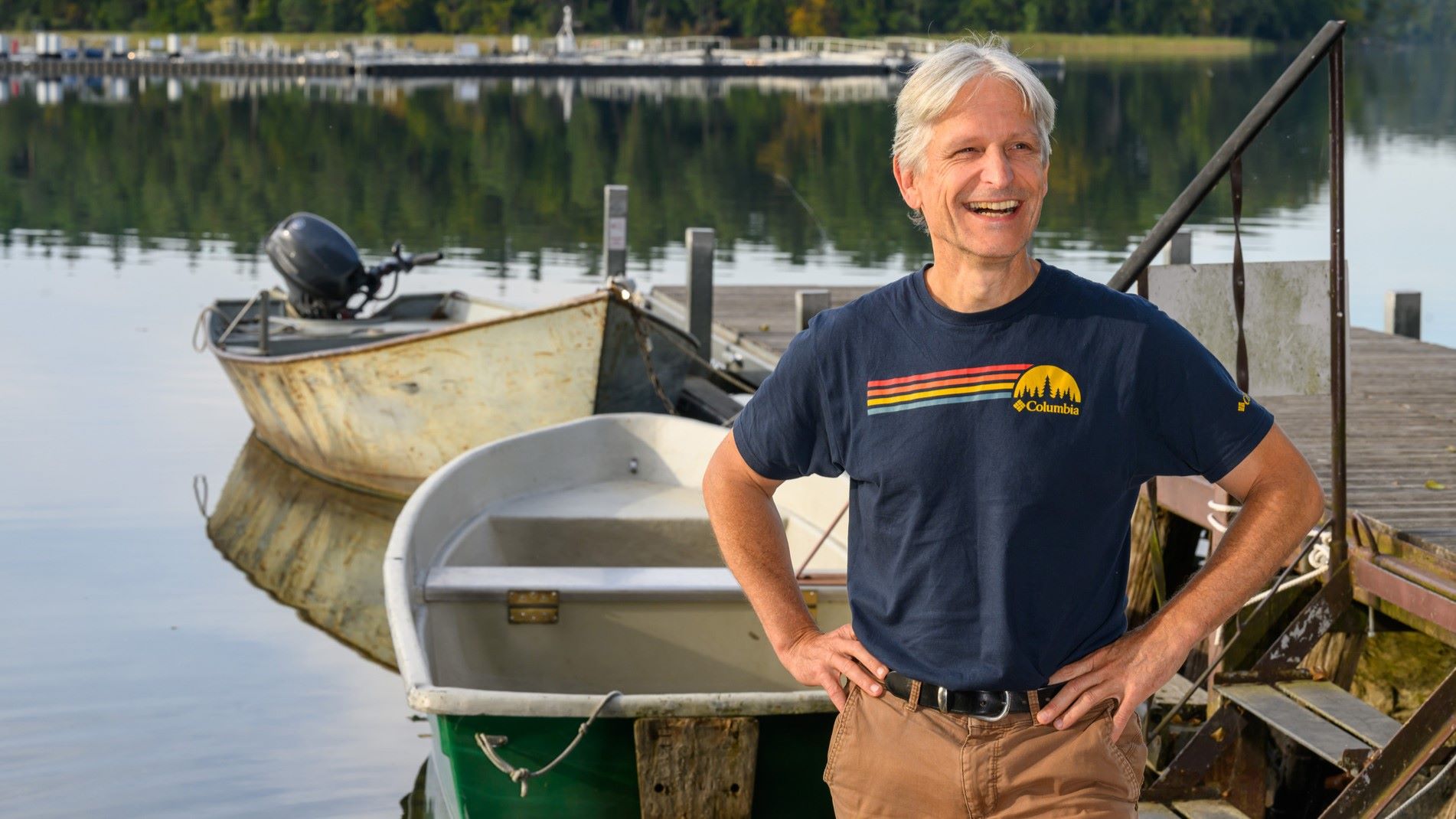
HPG: On top of that, we’re located quite far from IGB’s headquarter in Berlin. Many qualified people prefer to live in the city than out here in the countryside. Yet the countryside has not only disadvantages but also many advantages. The visiting researchers we host here always really enjoy being part of our community. They come to Stechlin from all over the world, including Canada, China, the Philippines, India and South America. They always look back fondly on this very close-knit location.
Have you drawn any conclusions from the work done so far? Can you recommend a co-leadership arrangement in good conscience?
HPG: A problem shared is a problem halved (laughs). Having two different perspectives helps us make more well-considered decisions. Dividing up tasks also makes sense if you want to maintain your academic focus.
SW: When you’re on your own, you often have a deputy. But co-leadership is quite a different matter! I think it’s great that we can both make decisions. We’re both in charge, which strengthens our position. Co-leadership also facilitates the generational transition. I feel comfortable in this role.
The interview was conducted by Adela Lukasczyk.