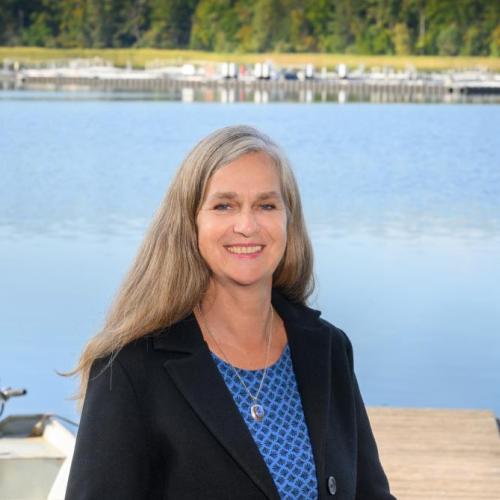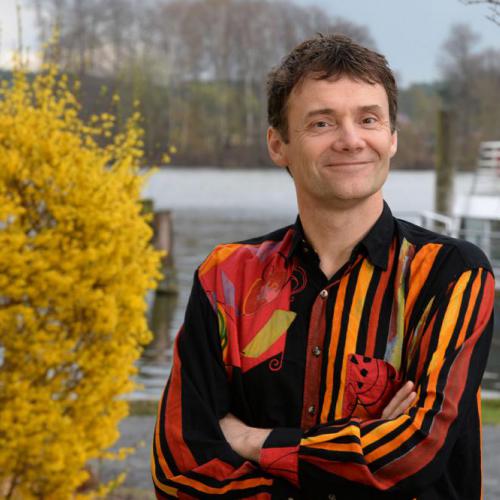

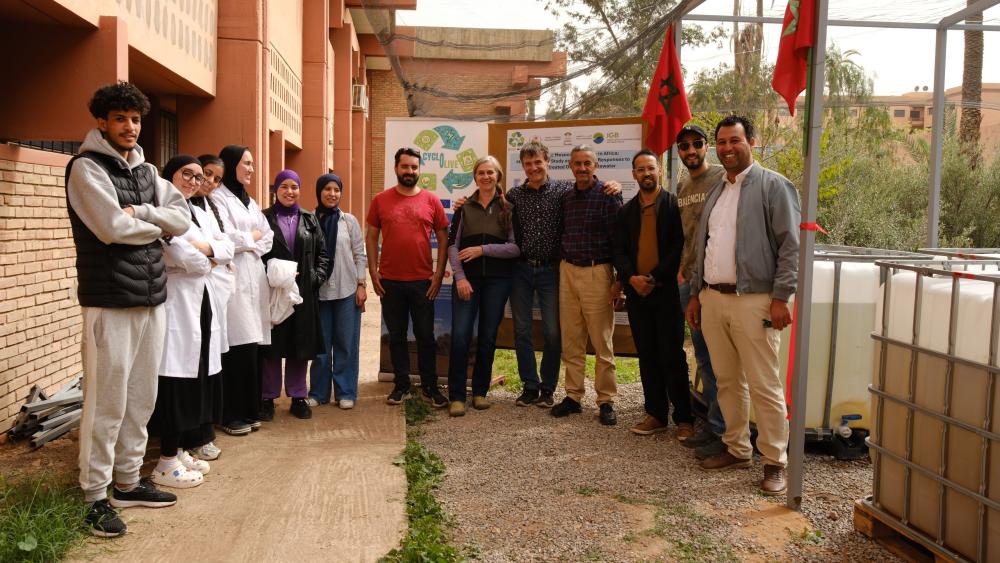
The team of IGB researchers and members of Cadi Ayyad University (CAU) in Marrakesh after installing the mesocosm research facility. | Photo: IGB
The production of olive oil creates besides solid, also liquid waste called olive mill wastewater. This effluent is characterized by high salts and organic matter concentrations in addition to high levels of polyphenols and other contaminants. Many plants produce polyphenols to ward off pests, and low amounts of polyphenols are essential for the quality of olive oil and beneficial for human health. “However, in the very high concentrations they occur in olive wastewater, phenolic compounds can be very harmful to aquatic organisms due to their antibacterial effects”, explains IGB scientist Dr Ayoub El Ghadraoui. “Especially if this olive oil wastewater is discharged without prior and adequate treatment it can heavily disturb the microbial communities in rivers, lakes and reservoirs, and thus the whole ecosystem function”, adds IGB scientist Dr Stella Berger. “On top of this there is a general water shortage in the region, and that is why olive mill wastewater poses an especially important challenge for wastewater management and the protection of aquatic ecosystems in Mediterranean countries”, explains their colleague, Dr Jens Nejstgaard.
CYCLOLIVE: Nature-based solutions for sustainable olive oil production and cyclic-sustainable-economy
As part of the EU-PRIMA-Projekt CYCLOLIVE, an international team of researchers, engineers and stakeholders is now developing cost-effective, NbSs to treat contaminated wastewater effectively, so that the treated wastewater can be reused for example for irrigation. “To this end, mobile constructed wetlands are being investigated in which the water is treated through natural biodegradation processes enhanced by biochar produced from olive mill solid waste using low tech solar-based technologies, and thereafter used in the constructed wetlands to increase the efficiency and reuse the by-products” explained Professor Faissal Aziz, CAU. To investigate the effects of such treatments on freshwater pelagic ecosystems, IGB in collaboration with CAU have set up an experimental outdoor tank system, also called mesocosms, in Marrakesh, Morocco. These enable researchers to test how different quantities of treated or untreated wastewater affect water quality, plankton biomass and composition, and ecosystem functions. A further aim for the new facility the is to transfer competence to support also other studies of aquatic ecosystem responses to different stressors in the future and develop mitigation efforts.
An unusual work trip: travelling by car from Stechlin to Marrakesh
In February 2026, the Faculty of Sciences Semlalia at the Cadi Ayyad University's campus inaugurated the mesocosm facility. “It is the first permanent research facility for aquatic mesocosms in Africa. This therefore also represents a significant step forward for environmental research on the continent”, said IGB researcher Dr Rafael Bermúdez-Monsalve. To transport the equipment for the mesocosm facility to Marrakesh, Dr Rafael Bermúdez-Monsalve and Dr Jens Nejstgaard drove the 3,700-kilometre journey by car packed to the roof with equipment. And they did so despite the floods in Spain and Morocco. With a bit of luck, they managed to get on one of the few ferries that went over Gibraltar. Dr Stella Berger joined the team in Marrakesh to setup and run the experiment. Finally, Dr El Ghadraoui, joined the last week and assisted Dr Bermúdez-Monsalve to drive materials including frozen samples in a special mobile freezer, back to IGB Stechlin, north of Berlin.
The research team from IGB is well-versed in the construction and operation of scientific mesocosm facilities. Drs Stella Berger and Jens Nejstgaard have coordinated the European mesocosm networks since the FP7 MESOAQUA, and then the H2020 projects AQUACOSM and its successor project AQUACOSM-plus, for 16 years. Stella Berger and Jens Nejstgaard also coordinate the large-scale LakeLab facility deployed in Lake Stechlin – one of the world’s largest mesocosm facilities in natural water bodies (LakeLab.de). Berger and Nejstgaard also founded the international network of mesocosm facilities, mesocosm.org, where the first permanent African mesocosm facility in Marrakesh, Morocco is now included (mesocosm.org).
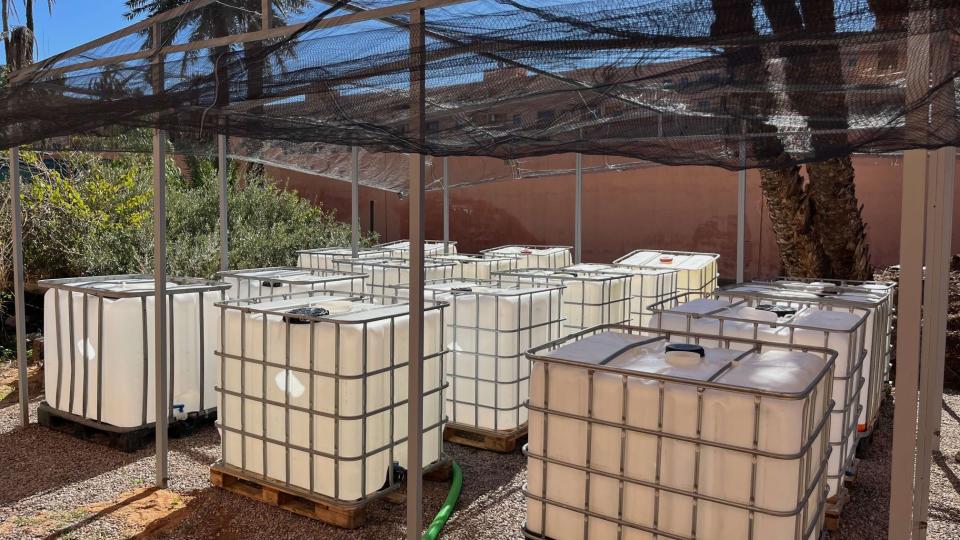
The Mesokosmos research facility in Marrakesh. | Photo: IGB
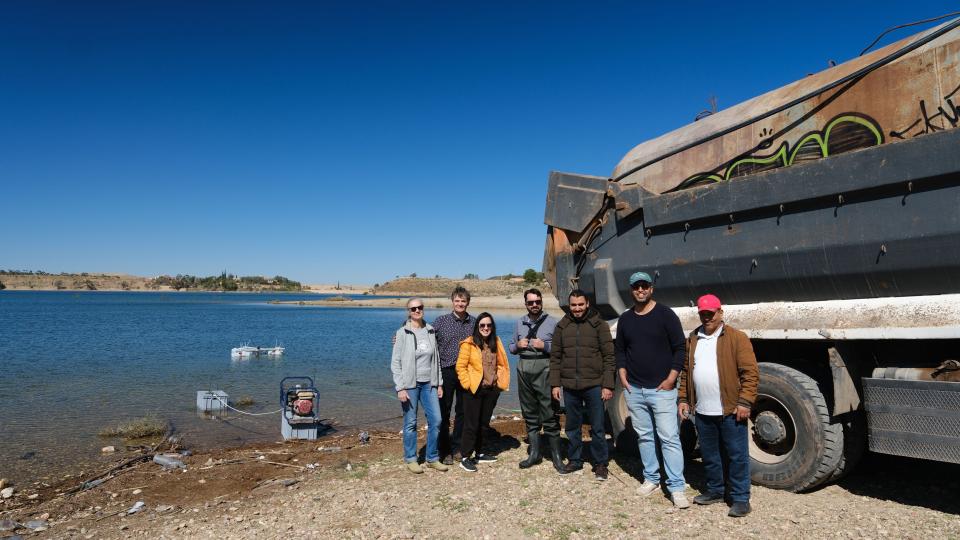
Water is drawn from Lake Lalla Takerkoust using the tanker lorry to supply the mesocosms. | Photo: IGB
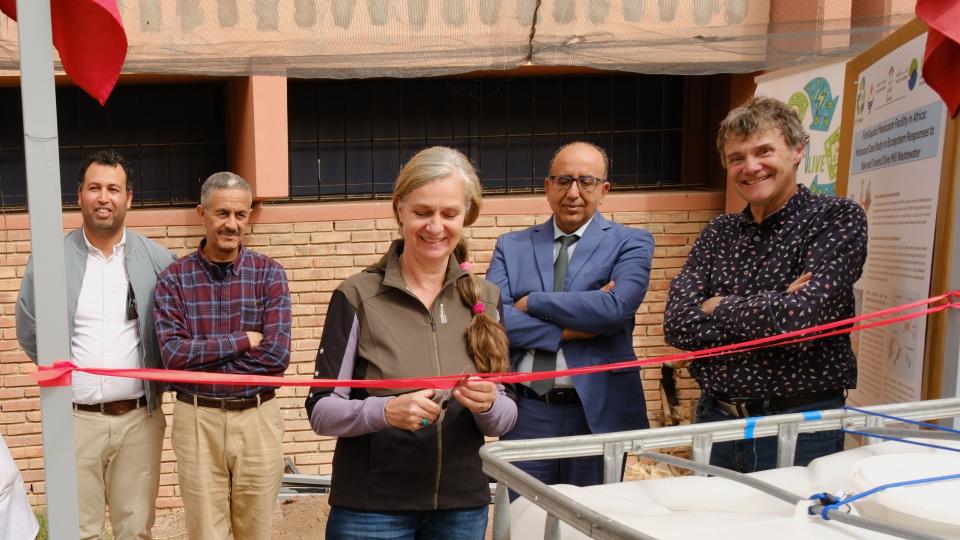
The inauguration of the Mesokosmos experimental facility by Stella Berger. | Photo: IGB