
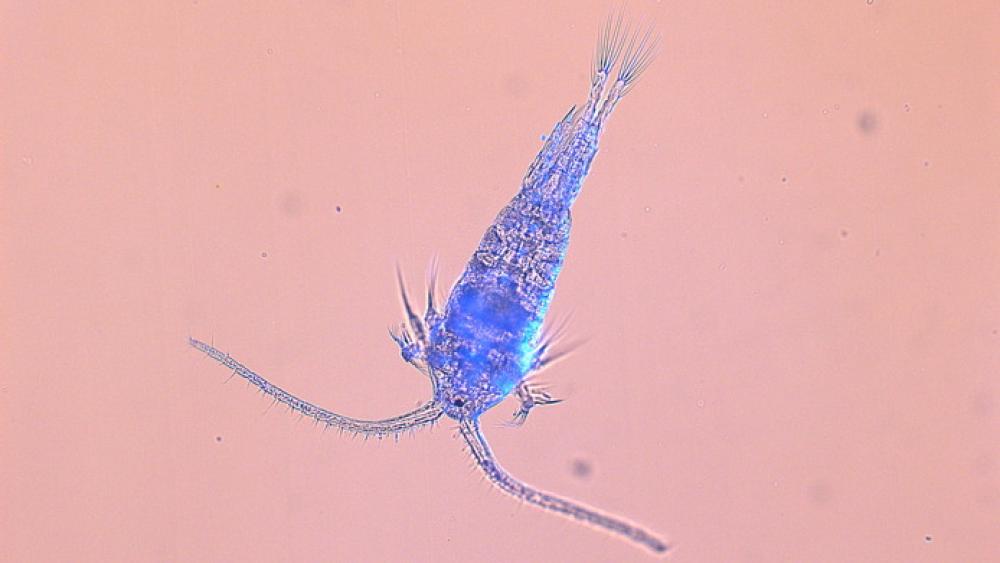
A copepod from Lake Stechlin. These tiny crustaceans can be found in a wide variety of water bodies – from small ponds to the oceans. | © Jörg Sareyka/IGB
Zooplankton plays a central role in aquatic ecosystems. These tiny, free-floating creatures feed on algae, for instance, and serve as a food source for larger organisms, such as fish. This makes them a vital component of the aquatic food web. At the same time, zooplankton communities are particularly sensitive to changes in their environment and are therefore well-suited as indicators for assessing the ecological status of water bodies.
“By collating data from hundreds of water bodies and spanning many decades, we can investigate on a large scale how these communities change under different environmental conditions,” explained Dr Jens C. Nejstgaard, an IGB expert on zooplankton. Together with Dr Sabine Wollrab, he has incorporated zooplankton data and environmental parameters – collected by researchers as part of the IGB’s own monitoring programme at Lake Stechlin – into the global dataset ‘Zooplankton International Geospatial’ (ZIG).
ZIG was compiled by numerous researchers from the “Global Lake Ecological Observatory Network” (GLEON). The dataset links information on zooplankton communities with data on water quality and characteristics of water bodies.
Wide range of water bodies, species and time periods
The range of data included is exceptionally broad:
- The water bodies included a range in size from small lakes covering 0.5 hectares to the Caspian Sea, which covers around 82,100 square kilometres.
- Geographically, the data extends from 47 degrees south to just under 65 degrees north latitude.
- For individual water bodies, the data goes back as far as 60 years. Depending on the dataset, samples were collected annually or even weekly.
- In addition to tiny crustaceans, ZIG also includes rotifers (Rotifera), which were recordedin 66 per cent of the water bodies surveyed.
This spatial, temporal and taxonomic scope makes ZIG a valuable basis for comparative analyses. Researchers can therefore examine not only snapshots in time, but also investigate how zooplankton communities change over years and decades. Furthermore, it is possible to analyse whether different groups of zooplankton react differently to environmental changes.
“The strength of ZIG lies not only in the large number of datasets, but also in the fact that biological observations are linked to environmental and water body data. This opens up new possibilities for identifying global patterns of change in lake ecosystems and for testing hypotheses specifically using long-term time series,” said ecologist and IGB researcher Dr Sabine Wollrab.
Informative – but not fully representative
Despite its global reach, the dataset does not provide a representative picture of all lakes. The water bodies included originate from existing research and monitoring programmes. Certain regions, water body types or time periods may therefore be over-represented compared to others. Furthermore, differences in sampling methods and taxonomic identification cannot be entirely ruled out when historical data are collated. Future data collection and contributions from other research groups can help to close existing geographical and methodological gaps.
“ZIG is already being used as part of several GLEON initiatives, which now look at specific aspects, as well as a synthesis paper summarising main trends observed in the global dataset, to which IGB researchers contribute,” Jens C. Nejstgaard summed up.