
Pollutants and matter cycles
Related News


Selected publications
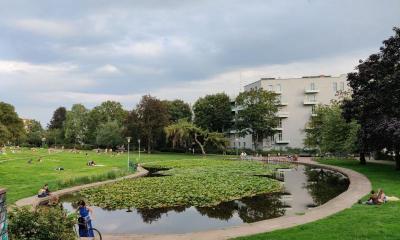
Tracing the occurrence and spatial drivers of organic contaminants in urban ponds along urbanization gradients
This study presents a multi-tracer approach to investigate the impacts of urbanization on pond pollution at the city-scale, linking trace organic contaminant data, urban hydrology, and urbanization measures. In Berlin, urban ponds contained a wide variety of dissolved organic contaminants, with water inflow being a more important driver of high contaminant concentrations than surrounding land use.
A Novel In Situ Experimental Setup for Studying the Impact of Bedform Celerity on 2D Oxygen Distribution in the Hyporheic Zone of Streams
The authors investigated the influence of dynamic hyporheic zones. They developed of a novel field-based setup that enabled the simultaneous monitoring of oxygen dynamics and bedform migration in a stream. Contrary to what has been reported in several studies, they observed more strongly oxygenated bedforms at the highest velocity studied.

Guiding Aquatic Reptile (Chelonian and Crocodylian) Conservation in the Face of Growing Light Pollution: Lessons From Experience
The paper reviews existing knowledge on how aquatic reptiles, especially freshwater crocodilians and turtles, respond to light pollution and discusses existing mitigation strategies. Learning from measures that have proven effective for related taxa, such as sea turtles, could be useful in setting up initial measures to protect freshwater reptiles against light pollution.
Mixtures of organic micropollutants exacerbated in vitro neurotoxicity of prymnesins and contributed to aquatic toxicity during a toxic algal bloom
This study investigated how organic micropollutants and the algal toxins prymnesins interact as mixtures in water extracts from the Oder River using neurotoxic effects on human nerve cells in vitro. The authors showed that prymnesins dominate the neurotoxic effects, but many of the detected organic micropollutants exacerbate the lethal effect of prymnesins.

Unpredicted ecosystem response to compound human impacts in a European river
The authors have compiled and analyzed the key environmental factors that led to the mass development of the brackish water alga Prymnesium parvum in the Oder in the summer of 2022. The data synthesis shows how multiple stressors combined to allow an alga that normally thrives in stagnant salt water to proliferate en masse in a completely atypical habitat.