


1) Biodiversity in a Changing World
News
Selected publications

June 2026
Hydrological Processes. - 40(2026)7, Art. e70625
Trade-Offs in Constraining Evapotranspiration Estimates in Complex Landscapes Using a Tracer-Aided Ecohydrological Model
ET interacts with multiple hydrological processes: groundwater recharge, lateral flow and streamflow. The inter-linkages become increasingly complex in ET-dominated regions with intensive management. We showed how tracer-aided modelling captures ET dynamics and how trade-offs between discharge and other observations are reflected in simulated hydrological flux/storage patterns.

June 2026
Hydrology and Earth System Sciences. - 30(2026)12, 3715–3739
Exploring impacts of forest management strategies on water partitioning in a drought-sensitive catchment using a tracer-aided ecohydrological framework
The authors developed a parsimonious, tracer-aided forest management scenario framework using an ecohydrological model, which was designed to isolate the dominant vegetation-structural controls on long-term water partitioning. Evapotranspiration was highest under conifers, exceeding broadleaf forests and agroforestry by 7 % and 11 %. Agroforestry exhibited the greatest groundwater recharge.

May 2026
Geophysical Research Letters. - 53(2026)10, Art. e2025GL120780
Prediction of Hydroclimatic Anomalies Using a New Isotope Precipitation Index
The authors used stable water isotopes to trace the origin of precipitation and are developing a new, isotope-based Evaporation and Moisture Recycling Index (iEMI). The iEMI can identify anomalous dry periods and links evaporation-driven precipitation to droughts in Europe, Africa, and Australia. This innovative index can help improve drought monitoring and optimize water management worldwide.

May 2026
Proceedings of the Royal Society B: Biological Sciences. - 293(2026)2070, Art. 20260566
Strategic choices of attack location allow predators to counter a collective prey defence
Shoals of sulphur mollies blanket the water surface of toxic sulphur springs in Mexico. The tiny fish survive attacks of birds through creating collective waves. New research now shows that their avian predators are adapting too, changing where they attack to avoid triggering the fish’s powerful group defence. The fish, in turn, appear to fight back with a surprising form of collective “memory.”

May 2026
Journal of Hydrology. - 675(2026), Art. 135627
Effects of temporary streamflow interruption on hyporheic oxygen dynamics
This study provides high-resolution, field-based evidence of the importance of accounting for short-term flow interruptions in river management strategies. It demonstrated that a one-day streamflow interruption of the side channel of the River Erpe caused a significant decrease in diel surface water oxygen amplitude and porewater oxygen concentrations, as well as a metabolic shift after rewetting.


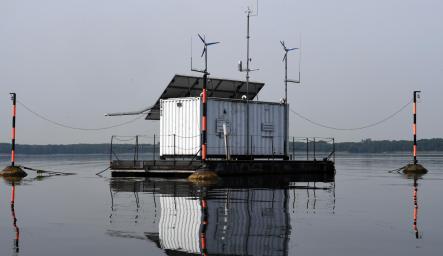
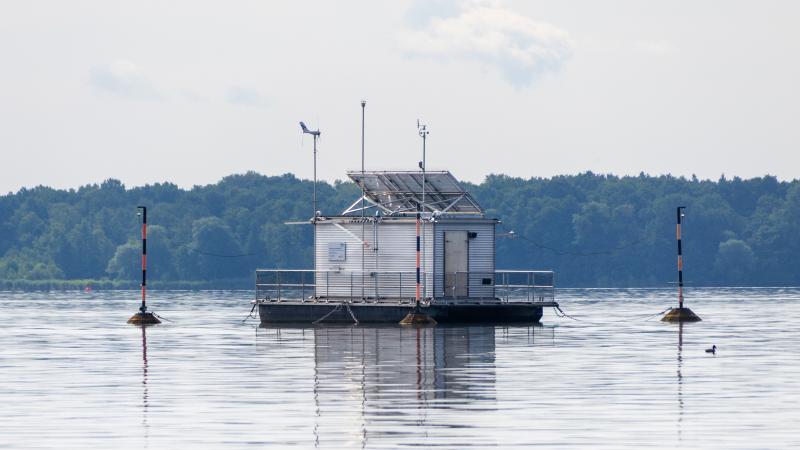
Monitoring stations
-
Water temperature-
-
Oxygen (rel./abs.)- / -
-
Wind speed-
Last measurement: No data available.
-
Water temperature-
-
Oxygen (rel./abs.)- / -
-
Wind speed-
Last measurement: No data available.
-
Water temperature-
-
Oxygen (rel./abs.)- / -
-
Wind speed-
Last measurement: No data available.