
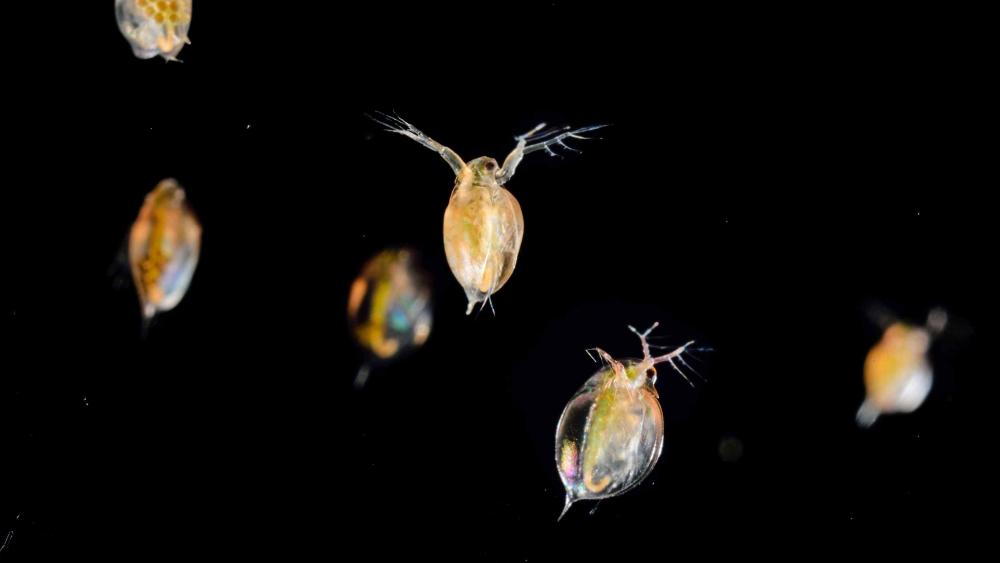
Example photo: Daphnia are among the most common small organisms found in water bodies and, as algae eaters, help to support their self-purification capacity. | Photo: Solvin Zankl
Nanoplastics raise particular concern because their tiny size allows them to interfere with cellular processes. They reach rivers and lakes alongside larger plastics, but current methods cannot reliably measure their concentration or ecological impact.
The doctoral project of Vanderville Villegas links nanoplastic exposure to shifts in the Daphnia magna microbiome and a consequent increase in vulnerability to infection. In his recent study, water fleas carrying a nanoplastic-altered microbiome produced more parasite spores and fewer offspring, while their survival remained unchanged. The animals had not been exposed to nanoplastics themselves, only to the nanoplastic-altered microbiome, pointing to the microbiome as the cause.
Another study, led by Kristel Sánchez and Kyla Sehner, tested whether nanoplastics act directly on the parasite. They do not. Nanoplastics did not harm the parasite at any stage of its life cycle. Whether the parasite was exposed to nanoplastics inside or outside the host, its ability to infect and reproduce remained unchanged. Instead, the harm fell on the host. Young water fleas exposed early in life died at much higher rates, reducing the pool of hosts available to the parasite.
Together, the studies from Justyna Wolinska's team show that nanoplastics reshape host-parasite relationships without acting directly on the parasite. They affect the water flea by altering its microbiome and reducing the survival of young hosts, and these indirect effects tip the balance in the parasite's favour. These factors should be considered when assessing the risks posed by nanoparticles.