
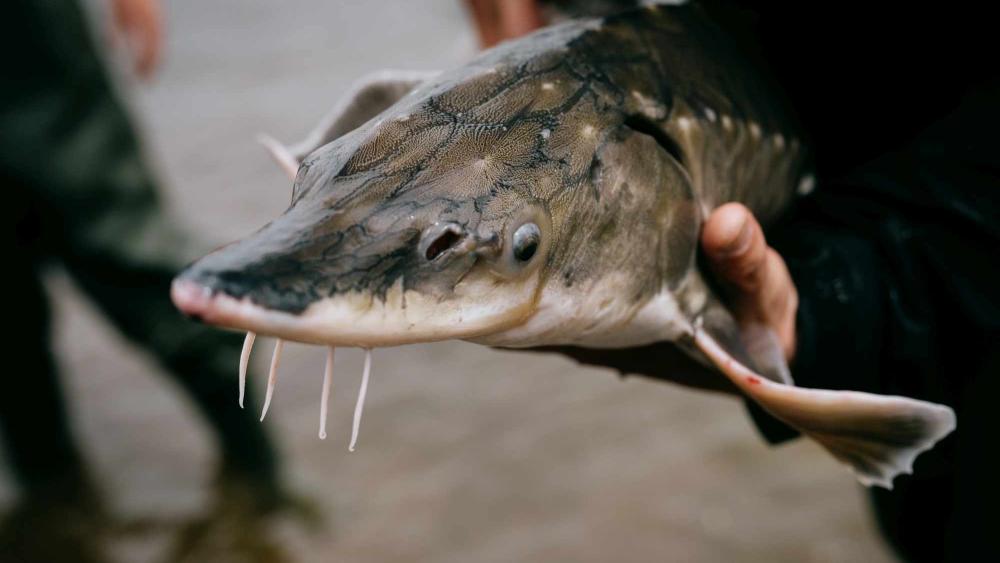
The sturgeon, in this case the Baltic sturgeon, is one of the largest migratory fish. | Photo: Jacobia Dahm
Many migratory species such as birds, bats, whales, and fish cross national borders to complete their lifecycle and need internationally coordinated action to protect them. The Convention on the Conservation of Migratory Species of Wild Animals (CMS) is an environmental treaty of the United Nations that entered into force in 1983 to meet such needs. With 133 Parties, including 132 countries and the European Union, CMS provides a global framework for coordinating international cooperations to enhance the conservation of threatened transboundary migratory species listed on the Appendices I and II. Although CMS Appendices I & II cover more than 1,100 species, freshwater fishes are vastly underrepresented. Only 23 freshwater fish species are included in the CMS Appendices. Nineteen of these are Acipenseriformes (sturgeons and paddlefishes).
Imbalance between the need for protection and CMS coverage of freshwater fishes
"Freshwater fishes are among the most endangered animal groups. According to the IUCN Red List, around a quarter of all assessed freshwater fish species are threatened with extinction. Another worrying statistic is that monitored populations of migratory freshwater fishes worldwide have declined by 81 per cent on average between 1970 and 2020", explained Prof. Sonja Jähnig, Acting Director at IGB and co-author of the study.
Fengzhi He, a professor at the Northeast Institute of Geography and Agroecology, Chinese Academy of Sciences and a guest scientist at IGB, is the lead author of the study. He added: “There is a stark imbalance between the need to protect freshwater fishes and how they are currently represented in the CMS Appendices. Such imbalance reflects the gaps in research on life history of freshwater fishes and conservation actions targeting on them."
Freshwater fishes are a ‘blind spot’
According to the authors, there are several reasons why migratory freshwater fishes are underrepresented in the CMS appendices. Firstly, there is a lack of comprehensive assessments of how many fish species migrate in freshwaters and across national boundaries to complete their lifecycle. Secondly, one-third of all described freshwater fish species are classified as ‘Not Evaluated’ or ‘Data Deficient’ on the IUCN Red List. Without baseline data, determining which species meet the CMS criteria of transboundary migration and unfavourable conservation status is challenging. Thirdly, many countries with transboundary river basins, particularly in Asia and North America, are not CMS Parties, which reduces the likelihood that species in these regions will be proposed and included in the CMS Appendices.
Including more migratory freshwater fish species in the CMS Appendices could profoundly enhance their protection
Most threatened transboundary migratory freshwater fish species are not included in the CMS Appendices, making it challenging to establish internationally coordinated conservation actions – particularly for long-distance migratory species. Without coordinated management at a basin scale, intentional harvesting, bycatch, habitat alteration and physical barriers can prevent them from reaching their spawning or feeding grounds.
The authors therefore emphasise the need to fully unlock the potential of CMS in advancing the conservation of migratory freshwater fishes. As a first step, more threatened transboundary migratory freshwater fish species should be identified and added to the CMS Appendices. International cooperation should also be enhanced in river basins that are diversity hotspots of migratory freshwater fishes, such as the Mekong and the Amazon. “The CMS COP15 will be held in Campo Grande, Brazil, in March 2026. CMS COP15 offers an opportunity to strengthen the protection of migratory fish species, including consideration of proposals to add more freshwater fishes to the CMS Appendices”, said Fengzhi He.