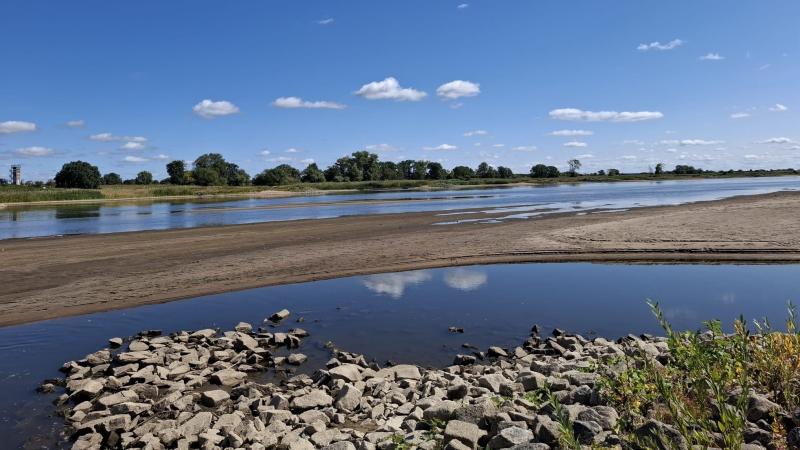

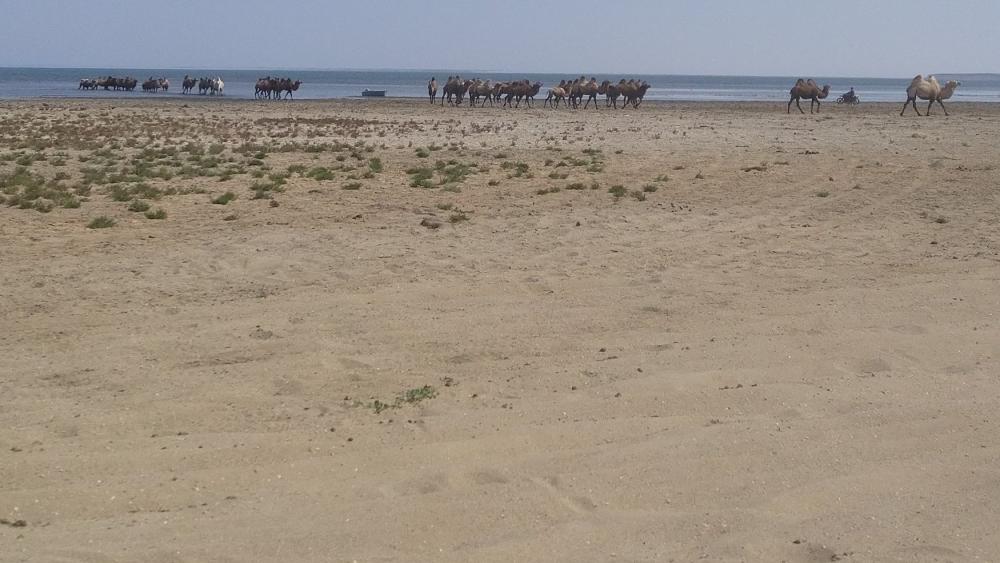
Where there was once a lake, there is now a desert. Hydrological restoration of the Aral Sea would result in massive reductions in carbon dioxide emissions. | Photo: Georgiy Kirillin
The desiccation of the Aral Sea is widely regarded as one of the greatest environmental disasters on Earth. Once the world's fourth-largest lake, it began to disappear in the 1960s after the rivers feeding it were diverted for large-scale irrigation projects. Today, it has been transformed into an extensive saline desert, with severe social and ecological consequences. New research published in Science and led by scientists at the Centre for Advanced Studies of Blanes (CEAB-CSIC) shows that the dessicatedAral Sea bed is not only a symbol of environmental loss: it is also a key component of Central Asia's carbon balance and a climate mitigation opportunity that has gone largely unnoticed.
Lakes and inland seas play an important role in the global carbon cycle because they accumulate organic matter in their sediments over long periods, storing carbon that was originally removed from the atmosphere by plants and algae. However, when these systems dry out, this carbon storage function can be reversed: sediments become exposed to the atmosphere, organic matter decomposes, and carbon is released back into the atmosphere as carbon dioxide.
The study reveals that sediments exposed by the retreat of the Aral Sea have released 748 megatonnes of CO₂ to the atmosphere since 1960. At the same time, the researchers found that a substantial amount of carbon remains buried within the former lake bed and that reflooding the system could prevent the release of a further 605 megatonnes of CO₂—roughly equivalent to almost three years of Spain's current human-caused greenhouse gas emissions. According to the authors, preserving this carbon could also have significant economic value in voluntary carbon markets, potentially generating between US$3.6 billion and US$18 billion (3,600–18,000 million US dollars) in tradable carbon credits.
Rafael Marcé, CEAB-CSIC researcher and lead author of the study, explains: "There is a hidden carbon treasure beneath the Aral Sea. If these sediments remain exposed, carbon will continue to be released into the atmosphere. If the sea is reflooded, that same carbon could shift from being a source of emissions to becoming part of the climate solution."
Núria Catalán, co-author of the study and researcher at CEAB-CSIC, adds: "When a lake dries up, we are not only facing a hydrological, ecological or socio-economic problem. The carbon cycle is also altered in ways that have so far remained largely absent from climate accounting."
Georgiy Kirillin is a researcher at IGB and also a co-author of the study. He has been conducting research at the Aral Sea on and off for over ten years and is very familiar with its condition: “My research, conducted twenty years after the Northern Aral Sea was saved as part of another study, has shown that the lake has returned to a condition similar to that before it dried up. For example, oxygen levels are well maintained. Therefore, the remaining part of the Aral Sea, which is still dry, also has great potential to reach a good condition.”
The carbon still buried beneath the former sea bed and what it could be worth
Although a significant fraction of the carbon stored in the Aral Sea sediments has already been released, the study highlights the 605 megatonnes of CO₂ that have not yet been emitted. The researchers describe this remaining reservoir as a climate mitigation opportunity that has so far been overlooked. If the sediments remain exposed, this carbon will continue to escape into the atmosphere. Conversely, restoring water cover over a substantial part of the dessicated sea bed could halt this process.
The study explores the potential economic value of these avoided emissions. Using 2024 voluntary carbon market prices for land-use and forestry projects as a benchmark, the authors estimate that preventing the emission of 605 megatonnes of CO₂ could correspond to between US$3.6 billion and US$18 billion in tradable carbon credits. This finding reinforces one of the study's central messages: restoring the Aral Sea should not be viewed solely as a costly environmental intervention, but also as a potential climate investment with measurable returns. Monetising the carbon stored within the sediments through carbon credits could help mobilise international funding, complement existing water-cooperation mechanisms, and improve the financial feasibility of reflooding.
The researchers note: "Restoration is often discussed mainly in terms of costs and economic returns. Our study shows that protecting these vast stores of carbon buried in sediments also has a climate value that could be incorporated into carbon-based financing mechanisms. This provides a new perspective, expressed in a language familiar to climate finance and carbon markets, and opens up a new conversation about how reflooding could be funded."
The study also draws on previous research by Central Asian scientists to discuss practical measures that could increase inflows to the lake, including improved irrigation efficiency, optimisation of water-transport infrastructure, and more coordinated governance among countries within the basin. Building on these restoration scenarios, the authors estimate that an investment of approximately US$9.7 billion in water management improvements could increase water inflows sufficiently to restore around 50% of the lake’s 1960 surface area, while generating an estimated 323 megatonnes of CO₂-equivalent tradable carbon credits.
The researchers emphasise that fully restoring the Aral Sea remains an immense technical, social and political challenge. Nevertheless, they argue that climate finance could act as a catalyst if combined with improved water management, international cooperation, and ecological and social restoration goals.
Although the Aral Sea is an extreme example, it is not unique. The study points to other regions where the drying of inland water bodies may have similar consequences for the carbon cycle, including the Great Salt Lake, the Salton Sea, Lake Urmia, Lake Chad, and the Caspian Sea, which is projected to undergo substantial drying over the coming decades.
The text is based on the press release of CEAB-CSIC >
Read more:
- After northern Aral Sea restoration: lake physics similar to before drying up (study from 2025 in Hydrology and Earth System Sciences) >
- Desiccating salt lakes as a source of greenhouse gases (study from 2024 in One Earth) >
- Freshwaters release methane – even when they dry out >
- An extreme environment of the hypersaline Aral Sea after desiccation (study from 2026 in Journal of Great Lakes Research) >