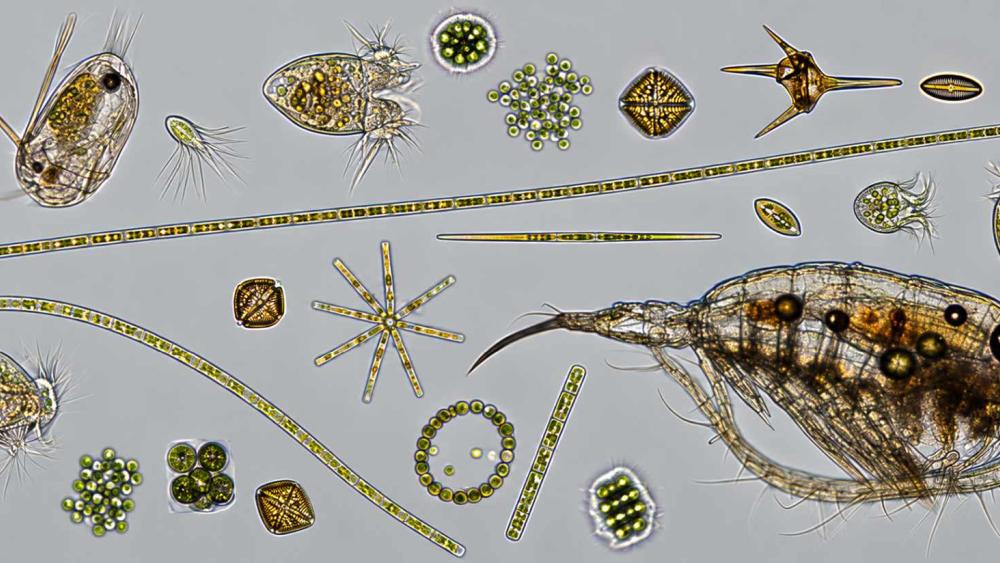
Plankon in Lake Stechlin, compiled from FlowCam images. | Photo: Gülce Yalçin
The FlowCam is a measuring instrument that analyses plankton samples using high-throughput, image-based flow cytometry. In addition to microimages, up to 40 other data points on the shape, size and number of particles are collected and analysed in the next step.
Dr Stella A Berger, an IGB researcher and head of the 'Phytoplankton Ecology' research group, has already used this instrument to record and quantify the relatively rapid responses of phytoplankton and microzooplankton communities to environmental changes. Conclusions can be drawn from this data about the effects of climatic extremes, loss of ice cover, nutrient enrichment or light pollution on species composition and the development of algal blooms.
‘The aim of the webinar was to share our expertise with other aquatic researchers and discuss open questions. With over 400 participants, the response was enormous, showing that image-based plankton analysis is of interest to many aquatic ecologists. Stakeholders from the field of environmental monitoring also joined the online event,” said Dr Stella Berger.
Large-scale experiments, such as those conducted at the IGB LakeLab on Lake Stechlin, generate vast amounts of data. To ensure these datasets can be analysed efficiently and in a way that allows for comparisons across different applications, the research team presented a new open-source image processing pipeline during the webinar. This pipeline standardises data from various FlowCam devices and software versions, optimises image processing and sorting, and supports optional machine learning-based classification. Combining FlowCam with AI-supported image processing enables fast, reproducible, high-throughput analyses of plankton in a variety of aquatic ecosystems.
'With our open-source pipeline, we aim to simplify the analysis of large FlowCam-based datasets and improve the comparability and reproducibility of the results. It is particularly important to us that researchers can adapt the individual processing steps flexibly to their own research questions," explained ECR scientist Dr Gülce Yalçın.