
Photo: Nowaja on Pixabay
Since the directive came into effect, there has been little improvement in the status of EU water bodies. This is not due to the goals themselves, but rather their poor practical implementation by the relevant responsible parties. By reviewing the WFD, the EU aims to examine 'how to promote circularity and access to critical raw materials in the EU while protecting the environment and human health'.
IGB scientists emphasise that aligning these objectives is not straightforward: scientific analyses demonstrate that the interests of certain industries, such as the mining sector, already contribute significantly to the significant shortcomings in the implementation of EU water legislation in Member States. Therefore, it must be emphasised that revising the WFD to include new exemptions for individual sectors could lead to a slippery slope effect, weakening the entire directive and undermining its vital role in Europe's sustainable development, including its economy.
Fresh water and inland waters are Europe's most important resources
It must be emphasised that, for Europe's societies and economy, freshwater is the most critical resource. Rather than weakening the WFD, the EU should focus on practical implementation, for example by accelerating and improving administrative processes and developing large-scale, integrative concepts. The latter provide promising approaches for analysing, weighing up and reconciling the many competing interests between freshwater use and protection.
According to IGB researchers, the WFD provides an excellent foundation for achieving this vital and urgent balance. Rather than producing competing and contradictory EU legislation in different policy fields, sustainable water management must be systematically considered across all relevant policy areas.
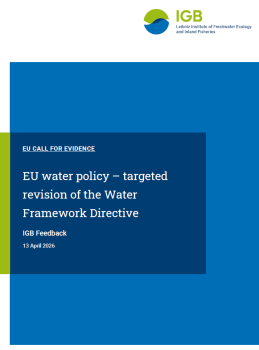
The full IGB feedback can be downloaded below this text.