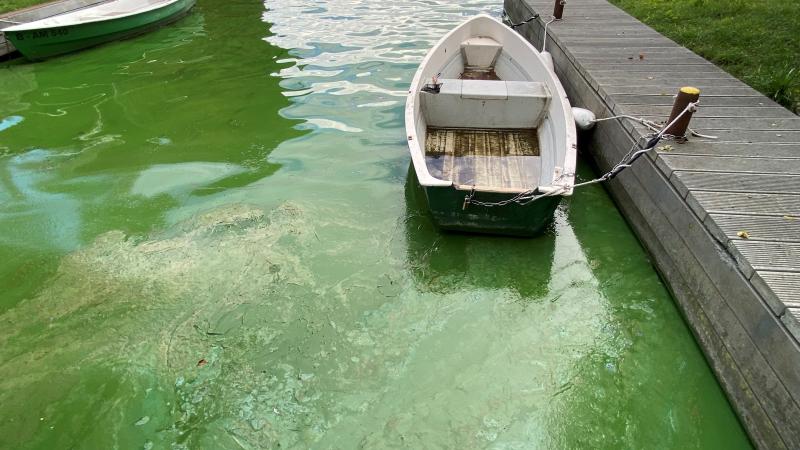

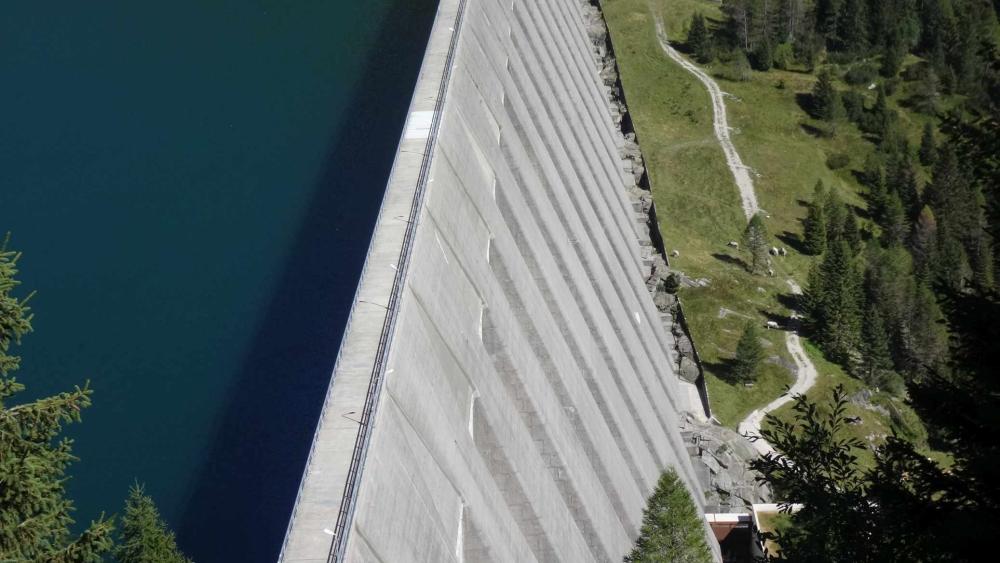
Example photo: A dam transforms a flowing freshwater ecosystem into a stagnant one. | Photo: Angelina Tittmann, IGB
Many freshwater fishes worldwide rely on migration to complete their life cycle by reaching their spawning grounds or habitats. The gilded catfish (Brachyplatystoma rousseauxii) holds a record, swimming 11,000 kilometers – about a quarter of the Earth’s circumference. This is the world’s longest freshwater migration, from the spawning grounds at the foothills of the Andes to the mouth of the Amazon and back. However, for this fish and many others, the journey often ends after just a few kilometers. Numerous obstacles, such as weirs and hydroelectric power plants, block their path.
The hidden cost of hydropower
Rivers have been fragmented globally with over 2800 reservoirs with a surface area over 10 square kilometres. Many of these big reservoirs are associated with large hydropower plants, while small hydropower plants often do not form a big reservoir and have gone unchecked. It is estimated that more than 80,000 small hydropower plants are operating or under construction worldwide, and the numbers continue to grow. Many of these existing and planned facilities are located in freshwater biodiversity hotspots, including the Amazon, Congo, Ganges, and Mekong basins.
“We see very different types of hydropower plants and varying developments across regions," said Prof. Sonja Jähnig, director of IGB. "In Germany, the Alpine region, and generally across Europe, smaller hydropower plants dominate. While many of them contribute little to the energy generation, they profoundly disrupt river ecosystems. Rivers in Asia and South America, which are home to high levels of biological diversity and many migratory species, are also subject to growing threat from hydropower development."
In a study published in Biological Conservation, a team with Sonja Jähnig and Fengzhi He summarized the impacts of hydropower on large aquatic and semi-aquatic animals. According to the International Union for Conservation of Nature’s (IUCN) Red List of Threatened Species, dams have posed a threat to nearly 4,000 aquatic, semi-aquatic, and terrestrial species. Globally, monitored populations of migratory freshwater fish declined by an average of 81 percent between 1970 and 2020, with damming among the leading causes.
No longer connected: cut off from the floodplains and the river's course
This risk results from a variety of negative impacts associated with dam construction. The loss of river connectivity plays a critical role here. River connectivity encompasses multiple dimensions: the three spatial dimensions – longitudinal connectivity along river network, lateral connections to floodplains, and the vertical exchanges with groundwater and the atmosphere. In addition, there is the temporal dimension regarding natural regimes of flow, sediment, and water temperature in river ecosystem.
“Hydropower development alters river connectivity in all four dimensions and poses various impacts on biodiversity, including habitat loss caused by impoundment, impeded species migration, increased injuries and mortality caused by turbines or hydropeaking effects”, explained Fengzhi He, guest scientist at IGB and professor at the Chinese Academy of Sciences.
Indeed, an IGB study, published in Conservation Biology, based on data from 122 hydropower plants revealed that about one in five fish died or were severely injured while migrating downstream through turbines – a risk that would increase when multiple hydropower plants exist along a river. Although fish passes have been installed for many hydropower plants to facilitate fish movement and reduce mortality, their overall effectiveness is often limited.
Protection gap for migratory freshwater fishes in the CMS
Despite their need for protection, freshwater fish are underrepresented in species conservation actions. One example is the Bonn Convention on the Conservation of Migratory Species (CMS). In a study, published in Nature Reviews Biodiversity a research team from the IGB demonstrated that freshwater fish are not adequately represented in the CMS appendices. Of the 1,100 species listed, only 23 are freshwater fishes.
Co-author Sonja Jähnig pointed to several reasons for this. "The low number of species listed in the CMS to date – only 23 – can be explained by three structural shortcomings. First, there is insufficient data on migration patterns and transboundary distribution. Second, there are significant gaps in knowledge regarding IUCN status – many species are classified as 'Not Evaluated' or 'Data Deficient.' Third, many countries with transboundary river basins, particularly in Asia and North America, are not CMS Parties, which reduces the likelihood that species in these regions will be proposed and included in the CMS Appendices."
COP 15 in March 2026: 325 additional freshwater fishes proposed for CMS
At the 15 th Conference of the Parties (COP 15) in March 2026 in Brazil, a UN report identified 325 species worldwide for which the authors are calling for CMS listing and further conservation measures due to habitat fragmentation. Fifty of the proposed species are found in Europe. “For Europe and the 50 species identified here, the report highlights a significant implementation gap: The scientific evidence exists, but river systems are heavily fragmented by migration barriers such as dams for impoundment and hydropower generation. A CMS listing would primarily strengthen international coordination, more binding measures to restore connectivity, and greater political prioritization”, said Sonja Jähnig.
Europe's protected areas provide limited benefit to river ecosystems
Protected areas are meant to preserve endangered species and stabilize ecosystems. But for many European rivers, this protection apparently falls short. This is the finding of a study in Nature Communications led by the Senckenberg Nature Research Society, in which IGB also participated. This study also emphasizes that a river’s connectivity is a key factor in successful conservation efforts.
The international research team examined the condition of rivers at over 1,700 locations in ten European countries across a period of almost four decades. They investigated how the diversity and composition of river organisms – especially small invertebrates such as insects and mussels – have developed in protected and unprotected areas. These so-called bioindicators show how healthy a river is. In most cases, no difference could be observed between protected and unprotected waters. For already high-quality, i.e., relatively clean, rivers, protection had hardly any measurable effects – presumably because these waters are already relatively unpolluted. Moderately or slightly polluted rivers, on the other hand, were only marginally improved by existing protected areas. Only heavily polluted rivers benefited, and only provided that protections encompassed large upstream sections of the river course and its tributaries.
"Protected areas were originally designated for terrestrial ecosystems – such as forests or habitats of rare birds and mammals. Rivers and their ecological characteristics were often overlooked in the process", said Sami Domisch, scientist at IGB and co-author of the study.
It is not only the size of the protected areas that counts, connectivity is also an important issue here
With regard to international biodiversity targets – such as the agreement to protect at least 30 percent of the Earth’s surface by 2030 – the study shows that purely area-based targets are insufficient if the quality and design of the protection measures are inadequate. The research team therefore advocates for a holistic approach to water protection planning in the future. “The connectivity of rivers is of central importance here. Instead of individual, small protected areas, large portions of the entire catchment area of a river must be considered – from its source to its mouth. This includes riparian zones, tributaries, and adjacent landscapes”, said Sami Domisch.
In Colombia: wild fish are not adequately protected in protected areas
A study (in Diversity and Distributions) on Colombia illustrates this point clearly :A research team led by IGB investigated the suitability of protected areas for freshwater fishes in that region. They used data about the geographical distribution of 1,313 freshwater fish species across 38,000 river sub-catchments in Colombia. They compared this data with existing protected areas, which aim to protect all animal species. In doing so, they found that whilst the area required for the effective protection of fish species is similar in size to that of existing protected areas, there is a significant spatial discrepancy: the optimal protected areas and the current protected areas overlap by only 25 per cent. Sami Domisch led the study and commented: “This gap highlights how important it can be to revise existing conservation strategies in order to more effectively preserve freshwater biodiversity – especially migratory fishes."
The study also revealed that it would be particularly important to grant protected status to the upper reaches of the Orinoco River, which, with 964 fish species, is as species-rich as the Colombian section of the Amazon. Among its inhabitants is the long-distance migrant – the gilded catfish.
In Germany, protecting the largest migratory fish – the European and Baltic sturgeon – remains a major challenge
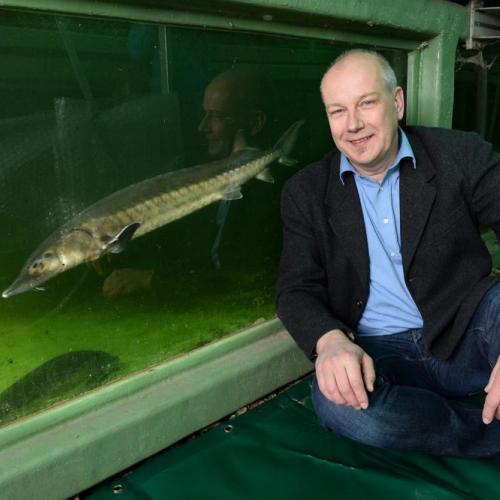
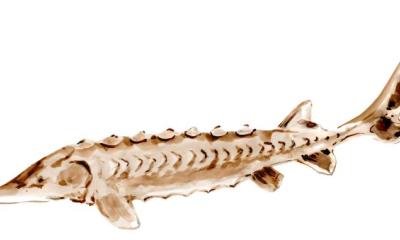
At IGB, Dr Jörn Geßner coordinates the reintroduction of two sturgeon species – the European and Baltic sturgeon – in Germany. Sturgeon are among the largest freshwater fish and migrate from the sea to their native rivers to spawn. They have been considered extinct in Germany for several decades. “That is tragic, because sturgeon have been around for more than 200 million years. They survived meteorite impacts and ice ages, but not human impact on the rivers", said the scientist. Currently, his team is investigating in the “HaffStör” project how the Baltic sturgeon uses its habitat in the Lower Oder and the Szczecin Lagoon, and which factors threaten the survival of the sturgeons released into the wild as part of the reintroduction program. Some of the released fish are equipped with transmitters whose signals are picked up by receiving buoys or by boat, allowing the data to be cross-referenced with information on habitat conditions and local influencing factors. The goal is to create risk maps for potential conflicts between the fish and various human activities in order to plan more targeted conservation measures. The results will be available next year – hat is, before the next “World Fish Migration Day,” which takes place every two years.